The Reader of Footprints
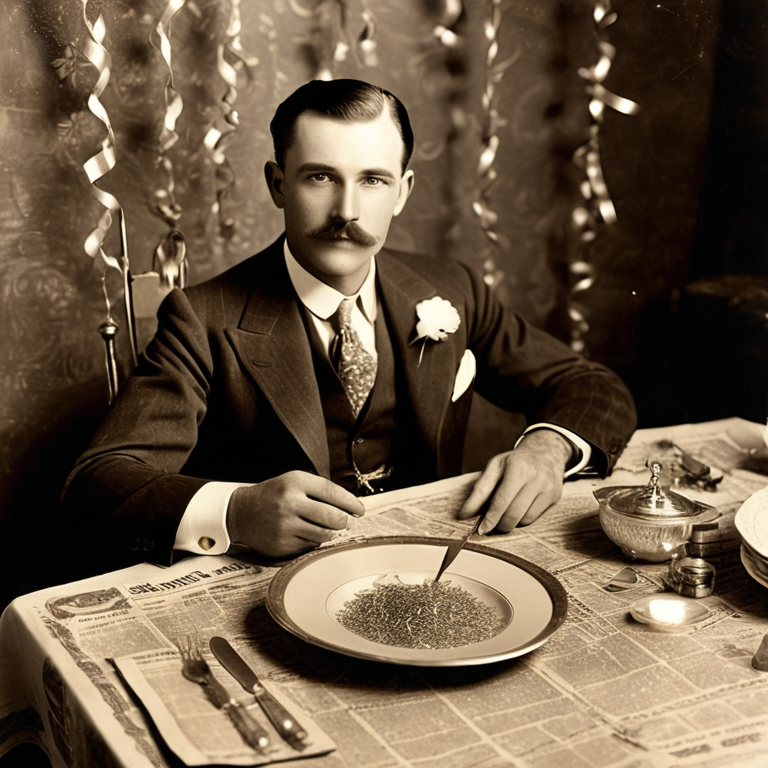
The guest at seat sixteen arrived early, and he has been studying the other guests ever since — not rudely; professionally. Watching operators at close range was his life's method before it was anyone's curriculum. You nearly met him in the gutter: a boy of fourteen going on fifteen who came around a Wall Street corner at a dead sprint with a fistful of quotations. The street taught that boy everything it knew. Then he turned around and taught the street.
---
The Seat
Richard Demille Wyckoff. He walked onto Wall Street in 1888 as a runner for a brokerage house — carrying prices between offices in the age when a fast pair of legs was market infrastructure — and across forty years, he kept the dates himself, 1888 to 1928, he climbed every rung the street had: runner, broker, owner of his own firm, operator, publisher. In 1907 he founded a magazine, The Ticker, later renamed The Magazine of Wall Street, and built it into one of the most influential financial publications in America. He is the man who helped make Jesse Livermore a household name. And all the while he was doing the thing nobody else thought to do systematically: studying the great operators of his era at close range — Livermore across a table, the market generals of the age watched the way a naturalist watches wolves.
In 1910 he set down what the watching had taught him, in a book about reading the tape — published, with magnificent gravity, under the pen name Rollo Tape. The most serious student of the ribbon in America signed his masterwork like a vaudeville act. I have loved him for it ever since.
Then the part of the arc I keep for this table, because it rhymes with why this book exists. Wyckoff grew wealthy — and turned evangelist. From 1922 he published exposés of the bucket shops, those rooms built so the public's money arrived faster than its understanding, because he had concluded that ordinary people were being systematically fleeced and could be taught to see. The runner boy went back down the street with a lantern. You and I know that walk.
The end is quieter, and I will not dress it up. In 1928, in a dispute inside his own house, he lost control of the magazine he had built. Health failing, he made his last act a school: in 1931 he founded a firm to teach his course in stock market science — two volumes bound in tan morocco and, in a flourish I confess I admire, leased to students, never sold. He died in March 1934. The course outlived him, taught by successor after successor, a descendant of it still sold today — a spell in continuous casting for some ninety-five years. The runner became the teacher, and the teaching outran the runner. That is the best ending the street gives.
One more thing about the teaching, and it is this seat's watermark. The snappy one-syllable name traders use today for his most famous pattern — the spring — was not his word. His own terms were "terminal shakeout," and the market being "on the springboard." The short name was added to the course after his death by his successor-teacher, Robert G. Evans. The tidy numbered diagrams everyone posts were not drawn by his hand either; he taught from real charts and real tape, and his students drew the maps afterward. None of this diminishes him — the concept is his, entirely. But at an honest table it gets said: even the legend-keepers' own legend needed a label. The ledger outranks the legend, all the way down.
The Spell
First, the lens. Pretend the whole market is one man — one immensely wealthy operator behind the scenes, running campaigns. He is not real, and Wyckoff knew it; this is a lens, not a conspiracy. (His era kept plenty of real conspiracies — two of them are seated at fifteen — inventing another would have been wasteful.) But look through it and the chaos organizes: the one great operator accumulates quietly while the public despairs, marks the price up, distributes into the cheering, marks it down. Your job is not to fight him and not to worship him. Your job is to read his footprints and walk where he walks — instead of into his traps.
And the footprint he prized above all others is the false breakdown. Watch, because it is beautiful.
A stock spends weeks trading on a shelf — a floor it refuses to fall through, a ceiling it keeps failing to break. Then one day price is pushed below the floor. Every alarm on the street rings at once: the protective orders resting under that floor fire, the breakdown traders pile on, the public sees the shelf collapsing. Now the test. If real selling floods out, the shelf was rotten — walk away. But if almost nothing comes out — if the dip is shallow and quiet, and price climbs calmly back onto the shelf — then the market has just rung every alarm it owns and found nobody left who wants to sell. The supply is exhausted. The one great operator has bought all there is to buy, and the markup is about to begin. The failed breakdown is the shelf's final exam — the terminal shakeout — and, he taught, the lowest-risk entry in the whole structure. Its mirror lives at the ceiling: a poke above that closes back inside is demand's failed exam, and the same reading upside down.
His arithmetic was spare, and it is all he hands us in numbers. Never take the position without an escape order, placed just below the low point of the shakeout — the market has already shown you its extreme; stand your exit behind it. And never take the trade at all unless it promises at least three dollars of gain for every dollar risked. Three to one, or no trade. That is the entire ledger row, and there is a quiet elegance in where the escape order stands: not at a distance you chose in advance, but just beyond an extreme the market has already printed. The exit is placed after the storm has shown its worst — a detail my laboratory finds more interesting than he could have known.
The Honest Ledger
Now the labels.
The price skeleton of the spell — the shelf, the break below, the calm recovery, the escape order behind the extreme, three-for-one or no trade — is fully mechanical, and it is written down exactly, in advance, as `wyckoff_spring` — pre-registered for the festival before the water was consulted. That name, we just agreed, is really Evans's; the lab keeps it because the world would not recognize "terminal shakeout" on a results board, and the chapter you are reading is the label.
What the tag on it says, in plain letters: untested. It reads beautifully. So did others that the pool later weighed and found wanting. The tag stays on until the water speaks.
And the honesty behind the honesty: his only sourced numbers are the three-to-one and the escape order below the low. Every other dial in the spec — how long a shelf must be, how tight, how deep the false break may go, how fast the recovery must come — is the lab's pre-registration, not his rule, chosen in advance precisely so nobody could tune them after peeking. And the parts of his teaching the spec cannot hold are named, not hidden: he wanted the shelf's story read in the volume — the climax, the quiet tests, the absorption — and he projected his targets by a counting method of his own. Neither fits in this first cast. What goes to the festival is the skeleton of the spell, and if the skeleton shows life, the flesh gets its turn.
One last note for the connoisseur of honest tables. The lab has measured, elsewhere, that tight stops placed at pre-chosen distances tend to die — storms overshoot. The shakeout's escape order makes the opposite promise: a tiny stop that survives, because it stands behind an extreme already printed rather than at a distance merely hoped. Those two findings cannot both be fully right in the same weather, and watching them argue is the single most interesting thing the festival run will settle. A good laboratory is a place where beautiful ideas are allowed to fight.
First heat (2026-08-17): the spring never fired — its quiet-range gate was written for 15-minute bars and daily bars never get that still. Not a verdict; the true trial waits on the finer clock.
For Your Grimoire
When the market rings every alarm it owns and nobody comes to sell, the silence is the signal — and never take the position without the escape order standing just behind the extreme the storm has already shown you.