J. Welles Wilder, 1978 · The Toolsmith
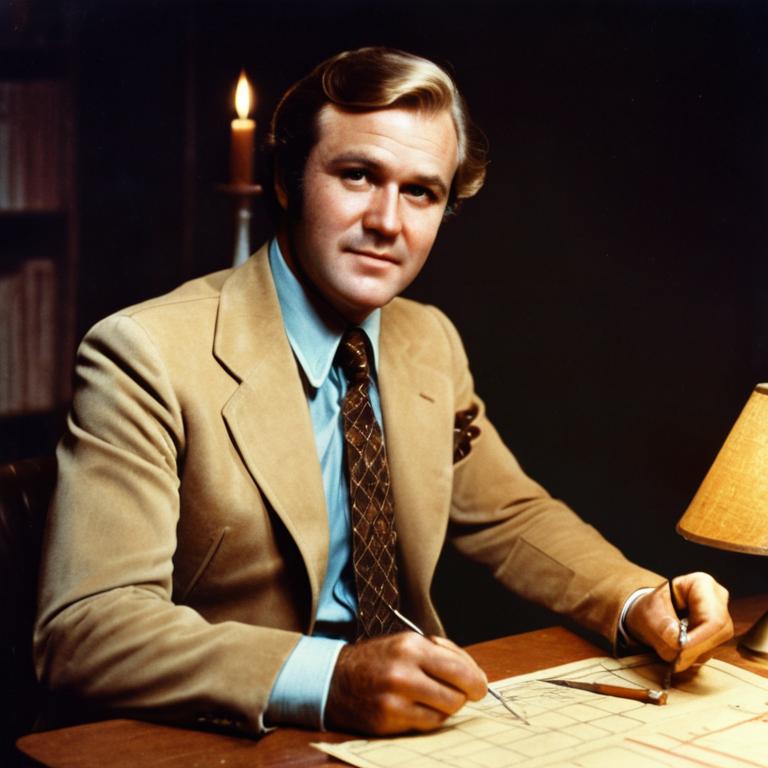
He never asks the market where it is going. He asks how far it has stretched, and how far it normally strides — and those two questions, asked exactly, became the measuring tapes half the world's spells now carry.
---
The Seat
The twenty-fourth chair belongs to the only master at this table who would rather show you his workshop than his ledger. He arrived tonight, I am delighted to report, with graph paper. While the other guests traded war stories over the soup, this one quietly asked me for a ruler — and when a wizard's table cannot produce a ruler on demand, the look you receive is not anger. It is measurement. You met him in the Machine Age as "the era's toolsmith," bent over graph paper somewhere in the American South. Here is the man behind the calipers.
J. Welles Wilder, Jr. Born 1935 in a small Tennessee town, a Navy stint, then a mechanical engineering degree from North Carolina State. He built houses for a living — an engineer turned real estate man in Greensboro, North Carolina — and somewhere between the houses he caught the market itch. Hold the houses in mind a moment, because they are not a detail; they are the training. A house is a structure where every vague word eventually costs money. "About level" is a mumble; a door either hangs true or it binds. "Strong enough" is a mumble; a beam is sized by arithmetic, or the roof conducts the arithmetic for you, later, at a worse price. A man who has answered to floor joists does not lose the habit merely because the structure in front of him is made of prices. So when he caught the itch, he came at the market the only way an engineer knows how to come at anything: define it, measure it, build the instrument. Where a trader saw a feeling, Wilder saw an unbuilt gauge.
And see the age around his bench, because the age is why the bench mattered. This was the era when magic became measurement — quiet rooms, humming metal cabinets that did arithmetic without opinion, and the discovery underneath the whole two decades: a machine can cast any spell you can write down exactly, and only those. Which exposed, in every brokerage and every trading book, an embarrassment nobody glamorous wanted to own: the craft could not define its own words. Its wisdom was real and its vocabulary was fog — a century of hard-won feel with not a number under any of it, useless to the tireless new caster humming in the basement. Before a single exact rule could be handed to a machine, someone had to sit down and decide what the craft's words actually meant, in figures, for any market you handed them. The era needed a toolsmith more than it needed another prophet. In Greensboro, between the houses, it got one.
Picture the two rooms of that age side by side, because his was the strange one. The markets his gauges were cut for were the loud rooms — wheat and sugar and copper and bellies of pork, the price of the nation's breakfast negotiated at full volume by shouting men in Chicago and New York. And then the workshop: a quiet man in the American South with graph paper and worked-out arithmetic, who did not need to stand in the roar at all. A gauge-maker never does. He needs the day's numbers after the roar has gone home — the high, the low, the close, laid out in rows — and he needs the patience to ask of those rows the two questions nobody had thought to ask exactly. Not where is it going, the question the whole roaring floor was shouting at itself all day. His questions were quieter and, it turned out, more permanent: how far has it stretched, and how far does it normally stride? Those are engineer's questions. They are what you ask about a beam before you trust it, and he asked them about markets, with a pencil, until the answers held.
In 1978 he gathered his gauges into a book and published it himself, through his own little firm — no great publishing house, no fanfare. A spiral-bound volume from Greensboro, full of blank tables the reader was meant to fill in by hand with a pencil and a pocket calculator, because in 1978 that IS how you ran an indicator: you were the computer. Feel what that format confesses about the author. He did not merely state his formulas and pose beside them; he made you work them, row by row, day by day, your own pencil doing the averaging — an engineer's conviction that you do not own an instrument until you have built one. The binding held a whole bench of gauges, more than the two this seat will teach. It was called New Concepts in Technical Trading Systems, and here is the joke history played, fully verified and still running: that homemade workbook of fill-in-the-blank arithmetic introduced the instruments that now ship inside every charting screen on the planet. Open any chart tonight, anywhere on Earth, and the odds are excellent that at least one line on it was born in that spiral binding. Within two years a great magazine was calling him the premier technical trader publishing his work today; he kept building tools for decades more, retired across the world to New Zealand, and died there in 2021, aged 85. Do the arithmetic of that life the way he would want it done: a man who began by handing strangers blank tables to fill in with a pencil lived long enough to see his gauges become the default furniture of every trading screen on Earth — and never once had to raise his voice, revise his formulas in embarrassment, or sell a single sealed envelope to get there.
And mark the deepest thing about him, because it is the era's whole creed wearing one man's face: he published everything. Formulas, worked examples, the lot — in a decade when lesser men sold sealed envelopes of secret systems, Wilder sold the arithmetic itself. Think about what a sealed envelope is, in this craft. A secret system cannot be checked by a stranger, and the Machine Age's whole gift was the checking: a rule written exactly can be separated from the hand that holds it and asked, alone, under oath — are you real? The envelope-sellers were shielding their spells from the one examiner that mattered. Wilder walked the other way and handed his instruments to every examiner on earth, and the instruments are still on the bench half a century later, still passing. He understood what this book has been teaching since its first page: the power was never in the secrecy. It was in the exactness.
Which returns us to the chair, and to why its guest would rather show you the workshop than the ledger. Around this table sit fortunes — audited ones, reported ones, legendary ones, and the court cases they dragged behind them. This guest brings no fortune story at all, and the omission is not modesty; it is the whole point of him, and the ledger below will honor it properly. A toolsmith is not weighed by his winnings, any more than the maker of compasses is weighed by the treasure other men sailed to. He is weighed by whether the needle points true in a stranger's hand, on a stranger's ship, half a century on. By that weighing — the only one he ever submitted himself to, in public, formulas showing — the quiet man from Greensboro sits at this table with a confidence the flashier guests might envy. Their stories require believing. His instruments require only reading.
The Spell
Wilder's seat holds no entry spell. It holds two measuring tapes, and you must understand why that is a greater gift, not a lesser one. Every trader alive says things like "it's stretched too far" and "give it room to breathe." Those are mumbles. A machine cannot hold too far in its metal hands, and — be honest — neither can you at three in the morning after two losses. Wilder's craft was turning mumbles into measurements.
The first tape measures STRETCH. Take the last fourteen days. Gather up the days that closed higher and average their gains; gather the days that closed lower and average their falls. Weigh the climbing against the falling and speak the answer as a single figure between zero and one hundred. Near the top of that scale, the recent move has been almost all climb — a bow drawn nearly to its limit. Near the bottom, almost all fall. He called it the Relative Strength Index — the RSI — and in his own book he marked the far ends of the scale, above seventy and below thirty, as the territory where a move has grown stretched. It does not say turn here. It says how bent the bow is, exactly, so that a rule about bent bows can finally be written in numbers.
The second tape measures STRIDE. Each day, take the market's true reach — from its high to its low, and if it leapt overnight, count the leap as part of the reach, because a gap is distance traveled whether you watched it or not. Average that reach over the last fourteen days. He called it the Average True Range — the ATR — and it is nothing more or less than the market's normal stride, this market, this month. Copper strides differently than wheat; a calm season strides differently than a wild one.
Now watch what the second tape makes possible, because this is the quiet revolution. "Set your stop a little below" is a mumble. "Set your ward two normal strides below" is an incantation — every word now a number a machine or a tired human can look up. The same trick sizes positions: risk the same number of strides on every market, and calm or wild, copper or wheat, your casts finally weigh the same. Half the exact spells cast in the world today, whatever school they serve, quietly carry Wilder's stride-tape in their pocket. In my own laboratory, nearly every ward is measured in his strides.
Your rite for tonight: pick one chart and find its RSI — it is on every platform, usually one click away. Do not trade it. Just watch the bow bend for a week. You are learning to read an instrument, the way he built it to be read: as a measurement first, a decision much, much later.
The Honest Ledger
Open the ledger, and this seat gets a verdict most masters never receive, because his instrument walked into my scrying pool wearing a spell.
The house's snap-back spell is built on his stretch-tape: when the bow is drawn to its limit in the right weather, bet on the letting-go. Cast in chop — the going-nowhere weather where snap-backs live — it is the rarest and strongest thing in my whole pack: it speaks seldom, a few hundred casts in years of replayed weather, and when it speaks it wins 63.2 of every hundred casts, with wins fat enough to feed the misses. Cast in a trending wind, the same spell fails — the bow you are fading is not overstretched, it is going somewhere, and it will happily drag you the whole way. His tape is the mirror of Donchian's channel: strong exactly where the channel starves, starving exactly where the channel feasts.
And the stride-tape? It earns the strangest line in the ledger: no verdict at all, because it is inside everything. You cannot weigh the ATR the way you weigh a spell, any more than you can ask whether rulers are profitable. It is how the wards in this laboratory know where to stand and how the sizes know what to weigh. Some tools are not soldiers. They are the quartermaster.
One label, for honesty's sake: Wilder sold his instruments' arithmetic openly, but his own trading fortunes were his own business and no audited record of them sits in my pack — the tools are weighed here, not the man. The tools weigh true.
For Your Grimoire
Measure the stretch and the stride before you cast anything — and fade a drawn bow only in the weather where bows snap back.