The Staircase
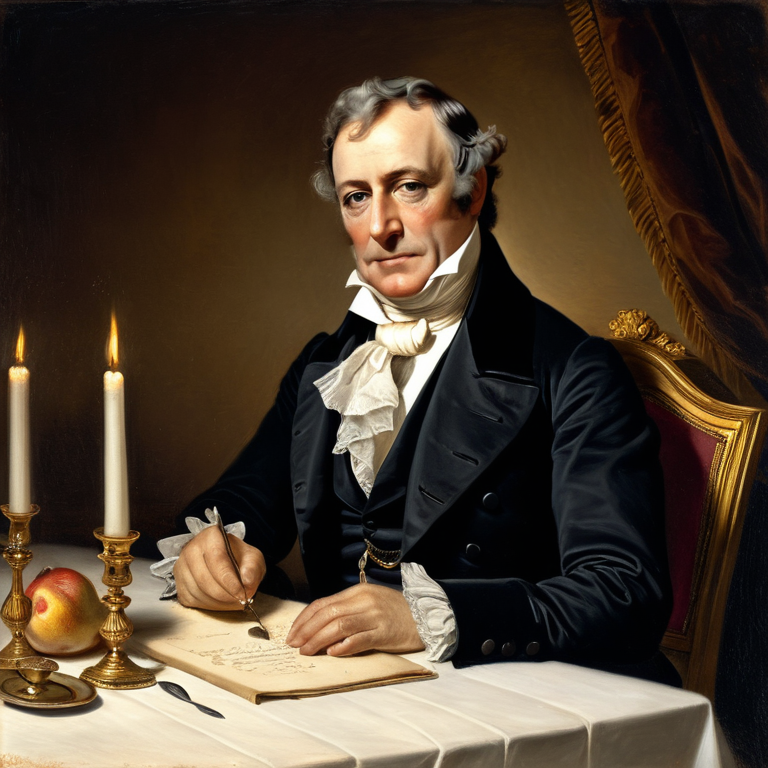
The guest at seat twelve is the quietest man at the table, and the room defers to him anyway. He held the most dangerous chair in British finance through the most dangerous week of his century, and he was calm — and the reason he was calm is the single most copyable secret in this book, which is why history refused to believe it and invented pigeons instead. Sit down. We are going to take a famous legend apart in front of you, and the man it flattered is going to come out of the wreckage better.
---
The Seat
David Ricardo. Born in London in 1772, a stockbroker's son, at his father's elbow on the floor from boyhood — and then, at twenty-one, he lost everything, and not to a bad trade. He fell in love with a Quaker girl, and he a Jew; they married; and both families closed like doors. His father cut him off. His mother, the story says, never spoke to him again. He began again with a borrowed few hundred pounds and a reputation for being worth backing — which means the man in this chair built one of the great fortunes of his age from roughly the same starting line as you.
How he built it, we know, because men who knew him wrote it down: an uncanny quickness for spotting when two prices that ought to move together had drifted slightly apart — step in, take a small, almost unremarkable percentage on a large, careful sum, step out. Again. And again. No heroics. No all-or-nothing afternoon. Turn after turn, each one modest, none of them fatal, for twenty years. Remember the shape of that. It is about to be tested by a cannonade.
Because in his last working years he took the biggest seat his floor offered: contractor for the government's war loans — one of the men who promised to raise millions for the Treasury against Napoleon, taking in exchange a great bundle of new national debt the market called Omnium, to be sold on at whatever premium fortune allowed. You buy a nation's promises in bulk, in wartime, before you know how the war turns out. There is no more dangerous chair in the City, and he sat in it loan after loan.
Then June 1815. The newest loan — the largest yet — closed on the fourteenth. Waterloo was fought on the eighteenth. Ricardo and his partners signed first and found out after; so did everyone; there was no other way to do it. And then three days in which London knew a great battle had happened and did not know who had won, because the signal towers go blind in fog and the truth was riding up the Dover road on a tired horse. The rumours came in waves — the Prussians broken, and the funds sag; Brussels safe on Monday, and they lift; Napoleon victorious — down; a rout, his army destroyed — up, and nobody dares believe it. Men who had signed for pieces of the loan went white. Some sold at any price that let them sleep. Some bought any rumour with a happy ending. Fortunes changed hands on stories that were false by supper.
And Ricardo, at his place, did his sums, made his notes in that precise hand, and quietly sold part of his own Omnium at a whisker of profit while the outcome was anybody's guess. Even his dearest friend could not match his stillness: the correspondence says the good Reverend Malthus, who argued economics with him by post the way other men play chess, had taken a small share of the loan through him, could not sleep on it, and asked to be sold out before the battle for whatever small gain was there. Ricardo did as his friend asked. His own share he kept working his own way. Same loan, same week, same facts: one man's nerves, another man's arithmetic.
Late on the night of the twenty-first, a spent officer in a chaise came hunting the Prince Regent through the West End with Wellington's dispatch and two captured French eagles. Victory — total. By morning Capel Court was a carnival, the funds surged, and the loan that had terrified its owners for a week was a blessing on everyone who held it.
Now the legend, and the ledgers, because this table opens them every time.
The legend says: Ricardo knew early. A secret courier — some say pigeons, the same tale they tell of his rival Rothschild — a million pounds swept off the table in an afternoon, the fortune of the richest economist in history explained by one perfect stroke of inside knowledge. Great economists repeated that story for two centuries.
The ledgers say: in our own time a patient scholar went through the archives and the price records, line by line, and the legend came apart — and the proof is beautiful. Ricardo had no early word, and we know it because he sold part of his Omnium at a modest profit before the true news arrived. No man with tomorrow's newspaper in his pocket sells today. He simply did in the panic exactly what he did in the calm: took small certain gains on a large frightening position, kept the rest, and let the event fall as it would. The loan paid him handsomely when victory came — and it was not a million, and he was not even the biggest contractor at the table. The legend is a lightning bolt. The truth is a staircase — thousands of small, cut, deliberate steps over twenty years — and the truth is the better story, because you cannot copy a lightning bolt.
He retired in his forties to green hills in Gloucestershire, wrote the books that made the economists claim him forever, and died in 1823 worth some £675,000 — one of the great fortunes of his age, assembled with no lightning whatsoever, out of profits so individually modest that history mistook the staircase for a bolt from the sky and had to invent the pigeons.
The Spell
What survives of his teaching is a set of three golden rules he pressed on his friends — and label it properly, because this book always does: Ricardo never wrote a trading book, and the rules were set down secondhand, by a journalist a generation later, endorsed as tradition by his great biographer. Remembered truth, not gospel. Here they are, as remembered:
Never refuse an option when you can get it. The right to act without the duty to. The oldest treasure at this table, and he is not the first seat to hold it up.
Cut short your losses. The moment a position turns against you, be gone. He did not argue with the tide; he stepped out of its way and waited for the next one.
Let your profits run on. Do not snatch a winner off the table for the comfort of it. The seat across the room — the poet of Amsterdam — teaches the exact opposite, and the argument between those two chairs is one of the longest-running in this book. Hold both. Neither man had an instrument for telling which weather he was in; that admission is part of the spell, not a flaw in it.
But the master-spell of this seat is none of the three. It is the sentence he wrote to his friend Mill, four years before Waterloo, in his own hand — the only quoted words this chapter will allow itself:
> "I play for small stakes, and therefore if I'm a loser I have little > to regret."
Feel how strange that is. The richest economist who ever lived is telling you his edge was that no single trade mattered. He could be calm in the panic because he had arranged his affairs so that being wrong was survivable — always, automatically, by construction. The men sweating around him that June week had bet their sleep. He had only ever bet his stakes. Calm was not his temperament. Calm was his size.
And that is the spell you can cast tonight, with no floor, no seat, no borrowed hundreds: size first, opinion second. Before you ask whether the trade is right, ask whether being wrong is survivable — not once, but every time, by construction, so that no afternoon in your ledger can ever be fatal. Do that, and you inherit the thing the whole floor envied and could not name: the ability to keep doing your sums while the room panics. Smallness is not your weakness. Sized right, smallness is why you get to be calm — and calm is why you are still there on the morning the tide finally turns your way.


The Honest Ledger
The rules are secondhand — and honestly so. They reached print a generation after his death, in a journalist's recollection, and his biographer files them as a tradition. Nothing in them contradicts what the ledgers show of how he actually traded; but they are remembered truth, and this table does not promote remembered truth to gospel.
They contain no numbers. "Short" is not a distance. "Small" is not a fraction. "Run on" is not a rule for when running ends. Any number bolted onto them would be ours, not his — so a study of cutting losses may fairly be run in Ricardo's honour, but never called a Ricardo backtest. The difference between those two phrases is this whole table's discipline in miniature.
The rule pair has a price, and he never priced it. Cut short your losses and let your profits run is a spell that pays when the tide marches and pays out, in small repeated cuts, when the water only slops about. His own century handed him long marching tides — a world war written as a price. The seat across the room, who took every profit without regret, made a fortune on the opposite commandment. Both were right in their weather; neither could read the weather in advance; and no honest ledger lets you pretend otherwise.
Part of his edge cannot be rented. He was a member of a closed floor, quick beyond his neighbours, and latterly a contractor buying a nation's debt at contractor's terms. The staircase is copyable. The marble it was built in is not, and this book will not pretend the venue paid him nothing.
And the audit itself — mark the verdict's shape. His legend was opened, line by line, and found false, and he came out better: not a prophet with a pigeon, but a man whose discipline was so consistent that it held at the exact moment history leaned on it hardest. That is the rarest outcome an audit can produce, and only one other seat at this table has managed it. It happened because the thing underneath was real.


For Your Grimoire
- Calm is not a temperament; it is a size. Arrange your stakes so
- Cut short your losses; let your profits run on — and know the
- Never refuse an option when you can get it: the right to act
- Fortunes are staircases, not lightning. Small certain turns,
- The proof of his innocence was his discipline: he sold a little,
- Opposite spells can both be true. He said let profits run; a
that being wrong is survivable by construction, and the panic becomes something you watch instead of something you join.
label: remembered truth, secondhand, without numbers. Any number you add is yours, and honesty requires you to say so.
without the duty to is worth more than it ever looks.
repeated for twenty years, built a fortune so large that history had to invent inside knowledge to explain it.
at a whisker of profit, before the news — because no man with tomorrow's newspaper sells today. Let your own ledger be the kind that could acquit you.
greater poet said take them without regret. The missing instrument is the weather — and knowing an instrument is missing is itself a form of knowledge.