The Battle for Survival

The Round Table · Seat 19 · Gerald Loeb, 1935
He wrote a book about not losing money and published it straight into the Great Depression — to readers who had just lost all of it. It sold anyway. Meet the man who kept his coat on in every market he ever entered.
---
The Seat
Come round the table to seat nineteen, next to Baruch — and keep an eye on those two, because their ledgers argue with each other in the most instructive way in this whole room. We will get there.
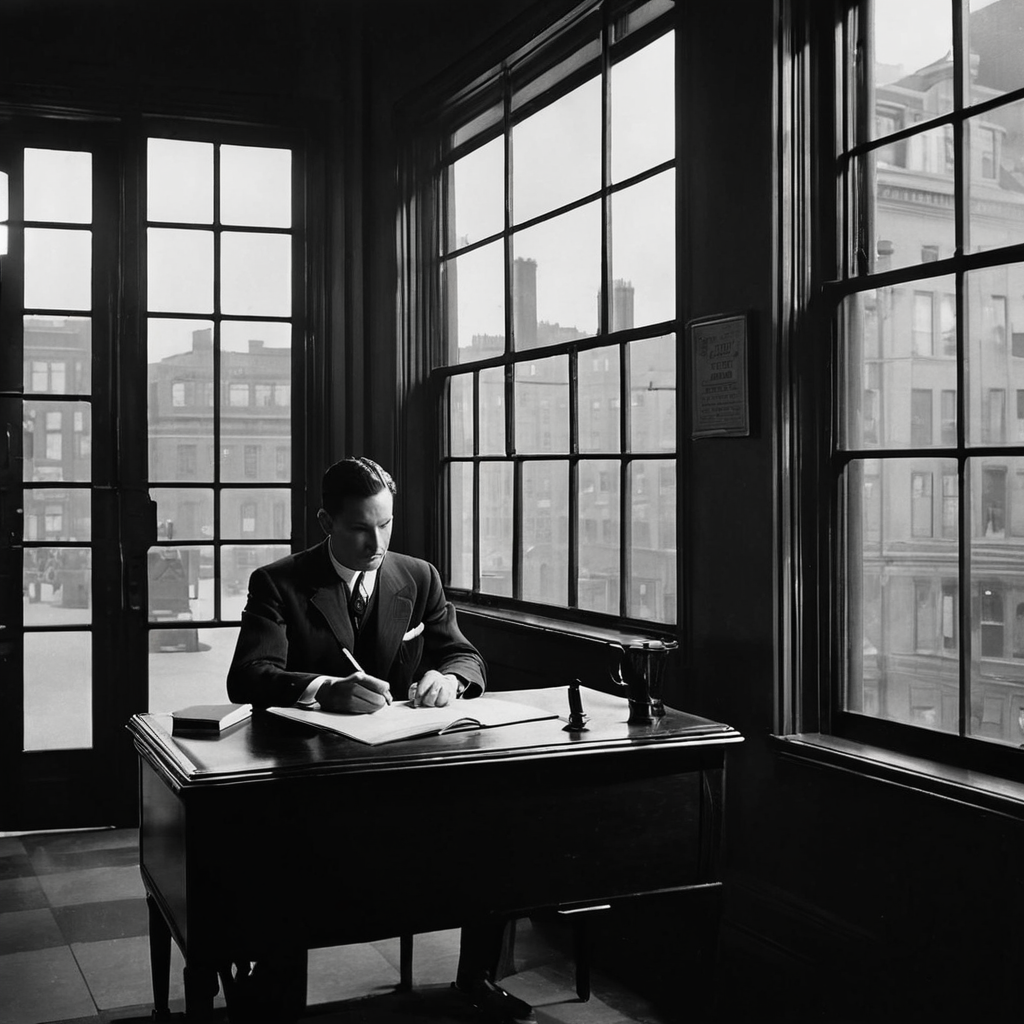
Gerald Loeb. Born in San Francisco in 1899, into the securities business at twenty-one, and by 1924 in New York with the great brokerage house of E. F. Hutton, where he rose across four decades to vice-chairman of the board. Here the ledger catches its first impossible title, and I show you the catch because catching is the skill this table teaches: half the books call him a founding partner of Hutton — a firm founded in 1904, when Loeb was five years old. Somewhere a flattering phrase outran the arithmetic, and then got reprinted for ninety years. Nothing sinister; a lesson free of charge: titles are copied, ledgers are checked.
Then 1929 — the event that made him, twice. Once in fact, once in print. The accounts say Loeb sensed the break coming and moved himself and his clients out of harm's way before the collapse, coming through the great grinding-down largely unhurt. And now watch the two neighboring seats, and learn the finest label lesson at this table. Baruch, at eighteen, carried the same legend — the man who sold out before the crash — and when a biographer finally opened his records, the legend failed the audit: Baruch was bullish into October. Loeb's version of the legend was never audited at all. It traces through his own columns and later retellings — self-reported, plausible, and unexamined, which is a different thing from either true or false. One crash. Two legends. One audited and broken, one never opened. This table prints all three labels and teaches you to taste the difference, because most of what you will ever read about great traders comes in exactly these three flavors.
What is beyond dispute is the doctrine the crash burned into him. In 1935 — into the very trough of the Depression — he published The Battle for Investment Survival, and the reported figure says two hundred thousand Depression-era readers bought a book about not losing money just after losing all of it. Perfectly timed. Fitting, from a timing man. Within a year of it stood the other great book of the decade, Graham's, and the two came at markets from opposite corners of the ring: Graham said price eventually obeys value — buy the dollar for fifty cents and wait. Loeb said there is no final answer to values — value is mostly hopes and fears, so wait for nothing, hold your capital ready to move, and treat the very act of holding as the risk. The argument never ended; whole industries descend from each corner. Forbes called Loeb the most quoted man on Wall Street, and in 1957 he endowed the awards for financial journalism that still carry his name — one of the few speculators ever memorialized for accuracy in print rather than size of fortune. He died in 1974: no scandal, no blowup, no courtroom. By this ledger's standards, a suspiciously clean exit.


The Seat's one dark truth, and then the spell
Loeb's premise deserves its own beat, because it is the light-in-darkness this book promises. Everyone who earns more than they spend is already in the game, he said, whether they chose it or not — inflation and taxes and inevitable mistakes see to that. So the question is never whether to fight the battle. It is whether you fight it awake. The book's title is not a metaphor. It is a diagnosis, and every rule below is a piece of armor.



The Spell
A spell is exact language — spoken precisely it works, mumbled it does nothing — and Loeb, almost alone among the great discretionary traders, wrote his exit spells down with numbers in them. Five pieces.
First: accept the small loss fast. His popularized rule: never let a loss grow past about a tenth of what you paid — and leave sooner if the signs are bad. He named the prompt accepting of losses the most important single device for safety of capital, the first key — and the act investors know least and practice least. In a reported exchange years later, a younger disciple asked whether Loeb really sold every stock that fell ten percent below cost; Loeb answered that he preferred to be gone well before that. Hold the image, because it is the seat's best: the stop was his fire escape, not his exit plan. You do not plan to use a fire escape. You make very sure the building has one.
Second: the trail off the top. The book's subtler rule: consider selling anything that falls ten to fifteen percent from the highest point it reached while you held it — gain or loss. Feel what that does: the same door now works on the way up. A winner that gives back its crown is treated exactly like a loser that broke its floor. This is de la Vega's goblin treasure, four centuries on, with a number bolted to it.
Third: cash without shame. Idle money is a position — often the best one on the board. Bargains appear only when fear is general; when everything is popular, the successful investor sits out and endures looking foolish, which is harder than it sounds and pays better than it looks.
Fourth: the concentration ladder. Beginners diversify, to learn and to survive their own learning. With competence, fewer positions, known deeply — over-diversification, he said, is poor protection against lack of knowledge. And for the learner, the most concrete rule in the book: one stock at a time, never more than a hundred shares, so that every new idea forces a decision — close the old before you may open the new.
Fifth — and this one made the lab stand and applaud across ninety years — write it down before you buy. Why you are buying, how much you expect to make, how long you expect to hold, how much you accept losing. On paper. Before. In 1935, Loeb demanded of his readers the exact discipline this laboratory demands of itself — the verdict rules signed before the trial. He called it good sense. We call it pre-registration. It is the same spell, and he cast it first.
Your rite tonight is his, unchanged since 1935, and it costs one index card. Take the next trade you are merely considering — under the usual vow: considering, not taking. Write the four lines: why; expected gain; expected holding time; loss accepted. If any line stays blank, the card has already saved you money, and you owe a dead man a drink.



The Honest Ledger
Verified: the career and its dates; the 1935 book and the 1957 awards; the Graham opposition; the doctrines and numbers above, from his own pages.
Reported, labeled: the 1929 sidestep (self-reported, never audited — the deliberate mirror of Baruch's audited legend one seat over); the two hundred thousand copies; the fire-escape exchange with his disciple. Charming, plausible, uncorroborated — enjoy them; do not lean on them.
Where his book goes vague, honestly: "consider selling" is not "sell" — the trail retains discretion, and any hard number inside his ten-to-fifteen range is a choice he left to you. His entries were never mechanical at all — buy strength, buy what the majority still calls speculative — feelings, not measurements. A rule that keeps a residue of mood is a spell half-written; the lab notes it without sneering, because half a written spell in 1935 was fifty years ahead of the field.
Measured, in this lab — the trial is set, not decided. His exits are the rare discretionary rules exact enough to test, so the lab has written the duel down: his fixed stop, his trail off the top, and both together, each riding one identical entry so that only his exits stand trial — and judged on what he actually sold, which was never glory: survival. Drawdown, worst day, time to recover. Verdict rules signed; the pool will speak in its own chapter. This seat prints no verdict it does not have. His own numbers — the tenth, the ten-to-fifteen — are his; the lab has added none yet.
For Your Grimoire
Treat every stop as a fire escape — built early, used without argument, never part of the plan. Trail your winners like your losers, hold cash without shame, and write down why before you buy: you are pre-registering your own trial, and the writing is the armor.