The Fraction
The Round Table · Seat 21 · John Kelly, 1956
Sixteen chapters ago, at Cardano's chair, I promised you a chain-smoking Texan who would reach the gambler's most expensive sentence from the other direction, wearing algebra. Here he is. He also taught a computer to sing.
---
The Seat
Come round the table to seat twenty, and meet the only master in this room who never traded at all — and whose one paper governs the size of half the serious bets placed on Earth tonight.
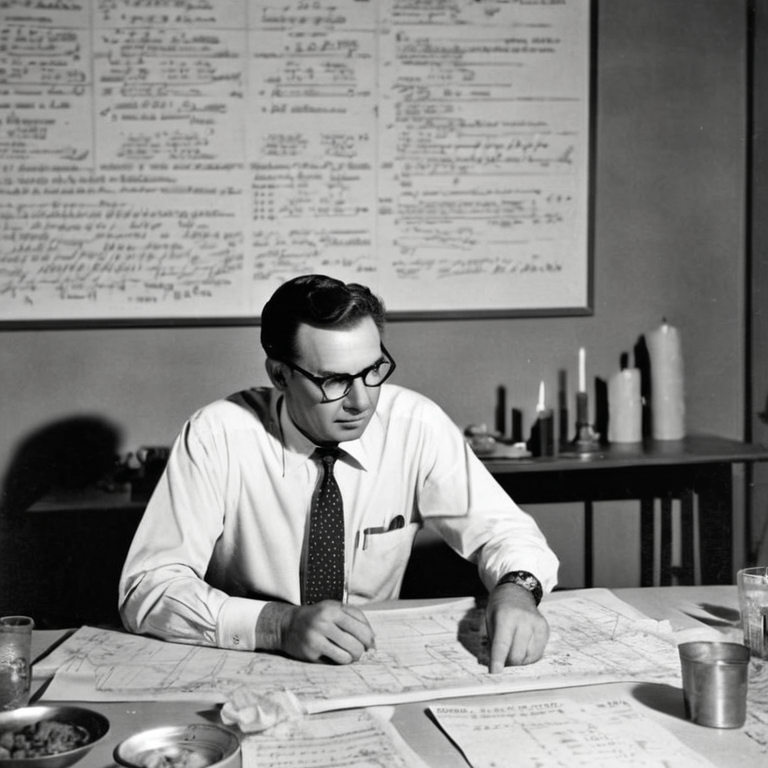
John Larry Kelly Jr., of Corsicana, Texas. Four years a Navy pilot in the Second World War; then a physics doctorate; then Bell Telephone Laboratories in New Jersey, the strangest wizard's tower of its century — the place that was quietly inventing the transistor, the communications satellite, and the mathematics of information itself. Into those polite corridors walked a Texan the biographies describe as a recreational gunslinger and a daredevil pilot, a man who did his physics with a cigarette going. He worked in the orbit of Claude Shannon — the man who had just discovered that information could be measured like water or coal — and in 1956 Kelly asked the question that seats him at this table:
If you truly have an edge — how much should you bet?
His paper answered it exactly. And here is the era's funniest verified footnote: he had written it under the title Information Theory and Gambling, and the telephone company's executives, horrified that the press might conclude Bell Labs was in business with bookmakers, pressured him to publish under the most boring disguise in scientific history — A New Interpretation of Information Rate. They needn't have worried. Almost nobody read it. The most important sizing formula ever derived spent its first years exactly as de la Vega's warning spent its centuries: sitting on a shelf, wearing a dull coat, waiting.
Who finally picked the lantern up? A young mathematician with a blackjack scheme, who told Shannon about it — and Shannon, of all the papers in all the world, handed him Kelly's. The scheme worked, the casinos changed their rules in self-defense, the mathematician took the formula to Wall Street, and the world took note. That story is a later seat's to tell in full; what matters here is the pattern you have now seen three times at this table: the writing survives its own neglect.
Two more things about the man, because this table loves its guests whole. In 1961 Kelly and his colleagues taught a room-filling computer to sing — the first song ever performed by computer speech synthesis, an old music-hall tune called "Daisy Bell." A visiting science-fiction writer named Arthur C. Clarke heard that demonstration, and years later, when he needed a dying computer to sing one last song in a film about the future, he chose the same tune. The machine that sings as it dies is this man's echo. And Kelly himself died young — in 1965, at forty-one, on a Manhattan sidewalk, of a brain hemorrhage — and it is reported, though no ledger can audit such a thing, that he never once used his own formula to make money. He forged the sword, hung it on the wall, and walked away. The rest of the world has been fencing with it ever since.

The Spell
I will teach it the way the lab lives it, because the reader's version needs no algebra at all — only one image. And first the founding metaphor, earned fresh: a spell is exact language — spoken precisely it works, mumbled it does nothing. Kelly's spell is the most exact sentence in this entire book, which is fitting, since it came out of the tower where exactness was being invented.
Your edge sets your size. Mathematically, not emotionally.
Picture a game tilted slightly your way — a coin that lands your side fifty-five times in a hundred and pays even money. You will win this game, if you survive to play it long enough, and both halves of that sentence are load-bearing.
Bet a trickle each toss, and your purse grows like moss — safe, and almost pointless. Bet the whole purse, and the first bad toss removes you from a game that loved you. Somewhere between the trickle and the plunge, the mountain of growth has a summit. Kelly's paper wrote down the summit's exact address: bet the fraction of your purse that equals your true advantage. In the tilted-coin game, your advantage is ten in a hundred — fifty-five wins against forty-five losses — so the fraction is a tenth of the purse, recalculated as the purse breathes. That is the whole incantation.
But the magic of the spell is on its dark side, where most spells keep their truth. Walk past the summit — bet bolder than the fraction — and growth does not merely slow. It bends downward. Bet boldly enough past the summit and a game rigged in your favor grinds you to nothing with mathematical certainty. Sit with that, because nothing in trading is less intuitive: ruin can win even while you are right. Courage past the fraction is not extra courage. It is a donation.
And now the sentence I crossed four centuries to close. Ask Kelly's formula what to bet when your advantage is zero, and it answers: nothing. Ask it what to bet when the game tilts against you, and it does not say bet small. It does not say be careful. It says do not play — the only winning size is no size at all. Cardano, after twenty-five years of losses counted one candle at a time, concluded that the greatest advantage in gambling lies in not playing. Kelly reached the identical sentence in one page of algebra, from a desk, without ever placing a bet. Four hundred years apart, one from wounds and one from mathematics — and when two roads that different arrive at the same door, wizard, the door is real.
The lab has stood in that doorway with its own lantern. It took real trading records — nobody's cherry-picked highlights, honest books at honest cost — and dealt each one twenty thousand simulated lifetimes to see what the streaks and the sizing actually do. Two receipts came back. First: honest books ran losing streaks of sixteen, seventeen, twenty, twenty-two in a row — not cursed books, ordinary ones; that is simply what streaks look like when nobody is lying, and it is why betting past the fraction is a death sentence with a delay on it. Second, the darker receipt, Kelly's dark side confirmed in the lab's own hand: for a book whose edge was negative, there was no survivable size at all. None. Sizing bought time — it never once bought survival. You cannot shrink your way out of a bad spellbook. The fraction is a servant of the edge, and serves nothing.
So the rite, tonight, and it is the shortest and hardest in this book. Take the trade you are considering — under the vow, as always — and write your advantage down as a number you would defend to a stranger: out of a hundred rounds of this exact situation, how many do I honestly win, and what does winning pay against what losing costs? If you can write it, the fraction exists and you may go and learn its arithmetic — it is one line. If the page stays blank — and the first night, wizard, the page stays blank for nearly everyone — then Kelly has already spoken: the fraction is zero. Zero is a size. It is the most underused size in trading, and the only one that is always, unconditionally survivable.
The Honest Ledger
Verified: Corsicana; the Navy years and the physics doctorate; Bell Labs and the Shannon orbit; the 1956 paper and the executives' retitling of it (the tale is told by the formula's own historian, and the paper's two titles are both on the record); the blackjack lineage that carried it to markets; the singing computer of 1961 and its long echo; his death in 1965, at forty-one. The gunslinger-and-daredevil color is biographical tradition — vivid, secondhand, and labeled as exactly that.
Reported: that he never used the formula for personal gain. Widely told, impossible to audit — a negative claim about a private life. This table finds it in character and leaves it labeled.
Measured, in this lab: the receipts above — streaks of sixteen to twenty-two straight losses in ordinary honest books across twenty thousand replayed lifetimes, and no survivable size for a negative book. The full ruin arithmetic lives in the lab and in the Survival chapter, where its darkest number belongs.
The one warning the seat owes you: the full fraction assumes you know your edge exactly, and nobody does — an edge estimated from the past is always part mirage, and betting the full fraction on a mirage is how careful people die slowly. The old hands bet a fraction of the fraction. So does this lab. Kelly gives you the ceiling; wisdom furnishes the floor below it.

For Your Grimoire
Your edge sets your size — and when you cannot write the edge down, the edge is zero, and the fraction is zero, and zero is a size. Sizing buys time; only the edge buys survival. The man who proved it never placed a bet in his life, and he agrees with the man who lost every day for twenty-five years. When those two agree, believe them.