The Lady in Black
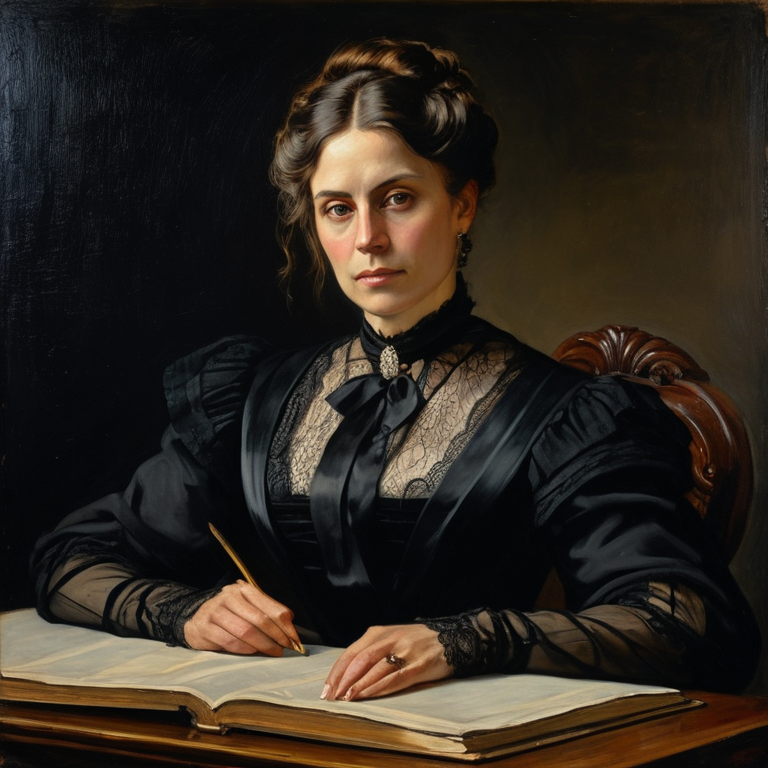
Pull out the chair quietly. The guest at seat fourteen does not rise to greet you — she nods once, the way a banker approves collateral, and goes back to her ledger. You met her at the end of the Gold Room visit, an ocean away from the burning hall, buying what nobody wanted. Tonight she is at my table, and I get to do the thing history never did for her: introduce her properly.
---
The Seat
Henrietta Howland Green. Born 1834 in New Bedford, Massachusetts, the whaling capital of the world, into a Quaker family of ships and ledgers. Her grandfather's eyes were failing, so from the age of six the small girl read him the financial pages aloud, every day — stock quotations, commodity prices, shipping news, performed at the fireside the way other children performed fairy tales. She opened her first bank account at eight. By thirteen she was the family firm's bookkeeper — one careful source says fifteen, and I remain delighted that the record of the century's greatest bookkeeper contains a bookkeeping dispute. Other girls of her class were taught needlework. She was taught the ledger, and the ledger never lied to her.
In 1865 her father and her aunt died within months of each other, and roughly six million dollars landed on her at thirty-one — much of it locked in trusts she resented to her last day. She contested her aunt's will, and lost, in the founding case of forensic counting: a Harvard mathematician matched thirty little downstrokes of a disputed signature against a genuine one and testified that so perfect an agreement by honest chance was a one-in-2,666,000,000,000,000,000,000 affair. The future richest woman in America enters financial history as the losing party to an improbability calculation. My scrying pool runs on exactly that kind of arithmetic, so I am professionally obliged to find this funny — and I do, and I suspect her bookkeeping soul eventually did too.
She married on her own terms — her fortune fenced off from her husband by written agreement before the wedding, her design and her father's. And in 1885 the fence proved itself: the bank that held her money failed, and its largest debtor turned out to be her own husband, his borrowing tangled into the ruin. The bank tried to hold her assets against his debts. She settled it, carted her securities down the street to another bank, and never trusted Edward with a dollar again. Hear both halves of that sentence, because both are true and both are her: she cut him off from her money forever — and she never divorced him, and she nursed him herself before his death in 1902. The fence was for the money. It was never for the man.
At the new bank she refused an office and worked from a borrowed desk among the clerks, in her plain black dress — Quaker plainness first, mourning black later. The press took the dress and built a name on it: the Witch of Wall Street. Which brings me to my chore, and at this table I do it with pleasure. My guest has been slandered for a century, and the slander sorts into three piles, so let me deal them out where she can watch.
Pile one: verified, and genuinely funny. She had a Skye terrier named Dewey whom she loved beyond reason. The city of Hoboken demanded a two-dollar dog license, and the richest woman in America, on principle, left the state of New Jersey over it — until her grown daughter quietly paid the two dollars and Hetty moved back. Her apartment doorbell was labeled "C. Dewey": the wealthiest person on the continent, hiding behind her dog's name. Asked why she so adored the animal, her answer survives firsthand: "He doesn't know how rich I am." Laugh — she meant you to. Then notice it is also the loneliest true sentence of the Gilded Age, and that she said it as a joke, which is the bravest way such a thing can be said. And one more, from beyond her own story: her son Ned's cork prosthetic leg later starred in a Supreme Court residency fight — a state arguing that a spare leg left in a house proved its owner meant to return. The family's luck with courtrooms was always theatrical.
Pile two: legend — told everywhere, verifiable nowhere. The cold oatmeal heated on the bank's radiator. Washing only the hem of the black dress. The hours hunting a lost two-cent stamp. Her own biographers throw up their hands and say fact and fantasy can no longer be separated in this pile, and a famous book of world records fossilized the whole heap by crowning her the greatest miser who ever lived. Label the pile. Step over it.
Pile three: provably false, or torn from context — the smear proper. That she died of apoplexy in a quarrel over skimmed milk: refuted — the record shows a series of strokes over months. And the cruelest one, that her stinginess cost her son his leg — this one I sorted with both hands. A true, unflattering core exists: when the boy first hurt his leg, she did once bring him to a free clinic in shabby clothes, and left when she was recognized. But the fuller record shows years of paid physicians, every remedy tried, cities moved to be near him, the boy carried in her arms in the street when he could not walk — and the family itself called the popular version simply wrong. The leg was lost to gangrene years later. The incident is real. The indictment is not proven. That distinction is this whole book's discipline, applied for once to a human being.
And the frame itself, plainly: a man who holds ready cash and lends into a panic is called a pillar of finance. A woman who did it better and longer was called a witch and remembered for oatmeal. Some of the men she out-lent got statues. She got an entry under "miser." I have kept ledgers across many centuries and I know a cooked one when I read it. This seat is the correction.
She died in 1916 worth an estimated hundred million dollars — the richest woman in America, arguably in the world. Both her children died childless, and the fortune of the age's most famous miser scattered, in the end, into colleges, churches, and hospitals. She would have checked the arithmetic on every bequest. I like to think she did.
The Spell
Her method survives in her own words, said to a reporter of her century, and it needs no dressing up:
> "I buy when things are low and nobody wants them. I keep them until they > go up and people are crazy to get them. That is, I believe, the secret of > all successful business."
One sentence, four parts — and the first part is invisible.
Cash first. To buy when nobody wants things, you must be holding money at the exact moment nobody else is. That is the rarest discipline in this entire book. A great standing reserve of ready money is an option on every future panic — the right, never the obligation, to act when the sky breaks — renewed every morning, its premium paid in boredom. And her refinement, the part I underline in gold: the reserve earned while it waited, lent steadily against solid property she had inspected with her own eyes, callable home when the weather turned. Declining to buy on every ordinary day cost her nothing — declining is the one move in markets that is always free. Then, one day in a decade, the whole street needed money at once, and the only person who had any was the lady in black.
Only in the storm, and only quality. She did not buy everything cheap. She bought good things cheap — railroads with real traffic, land, government paper, loans secured by property she had personally gone and looked at. Quality, in her practice, has an exact meaning you can carry home: an asset that will survive the very panic that made it cheap. The panic is the sale. It is not the merchandise.
Sell to the crazy; be wary of the giddy. Read the sentence again: she keeps things until people are crazy to get them. The euphoria is the exit — and the warning. Before the great panic of 1907 she said, by her own account, that the rich around her were over-borrowed and a storm was inevitable, and she spent the giddy run-up quietly turning holdings into cash. When the storm arrived, the city of New York itself came to her desk, and she wrote the city a check and took its bonds in payment. Her price, by her own account: six percent, when she might just as easily have secured forty. Partly conscience — and partly craft: fair terms in a panic keep the borrower alive to repay you, and keep the city coming back next storm.
And no borrowed money. Ever. The deep floor of the whole method. She could never be forced to sell, because she never owed anyone the power to force her. In every crash of her long life, the drowned were, almost to a name, people who owed. Nothing could be taken from Hetty at the bottom. Her survival was not courage in the moment — it was arranged in advance, on paper, in the calm. She had no stop-loss, because solvency was the stop.
The Honest Ledger
Now the labels, because this table is honest or it is nothing.
She left no numbers. Not one. "Low," "nobody wants them," "crazy" — every dial in her spell is set by human judgment, her panic was an event of months read in newspapers and interest rates, and her holding period was years. Half her edge was a lending book — loans at panic rates against collateral she had walked around — which no chart test can represent at all. The other half was selection: knowing which railroad's traffic was real. Also invisible to a chart. A fast-chart imitation of Hetty Green would be a costume, not a method — her clock does not tick in minutes, and she built her whole life around not paying the tolls a fast clock charges.
What remains testable is the timing shell: buy after a violent fall, in something whose quality survives, once the falling has stopped falling, and hold toward recovery. That shell is now written down exactly, in advance, as `green_panic` — pre-registered for the festival, before any water was consulted. Daily bars, long only. Its soul is a stabilization gate: the lab has measured what happens to those who reach in while the knife is still marching, and Hetty never caught blades — "nobody wants them" is the exhausted churn after the fall, not the fall itself. Two exits run side by side: a standard lab bracket, reported only so she can sit beside the other masters and flagged as a violation of her method — and her own shape, no stop, patience bounded, solvency-sized. If the two disagree, her shape is the method and the bracket is the furniture.
And even if the shell survives the water, the report will say what I say now: every number in that spec is ours, none is hers. The lending yield, the selection, and the forty years of patience remain untested — and untestable — here. The pool weighs what it can hold. It cannot hold her whole spell. Few pools could.
First heat (2026-08-17, provisional): as coded on daily bars her spell lost (−0.217R holdout, 46 casts) — but its seven calm-weather casts went +0.29. Her patience clause may yet be the whole spell; the festival decides.

For Your Grimoire
Cash is a spell that only works if it was cast before the sky broke: keep a reserve no excitement is allowed to touch, let it earn while it waits, and buy only what would survive the storm that put it on sale.