The Man Who Counted the Faces
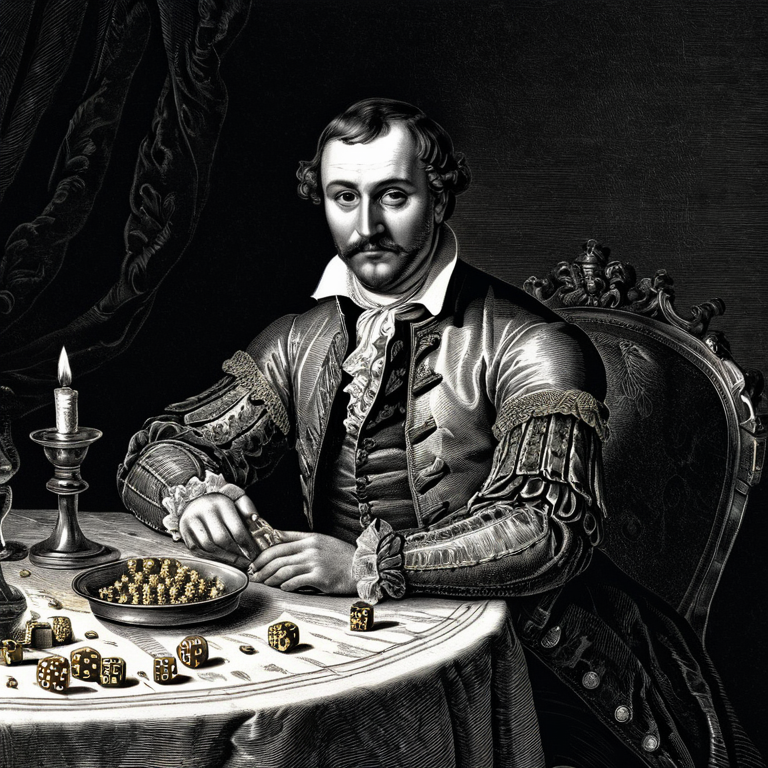
The first mathematician at my table, and the only guest who paid for his mathematics at the rate of a loss a day for twenty-five years. Come and meet him. Keep a hand on your purse.
---
The Seat
Come around the table with me. Past Thales, who is explaining olive presses to the salt cellar; past Leonardo of Pisa, who is counting something — he is always counting something. Here. Seat four. The old man in the physician's gown, with a gambler's eyes, and a knife at his belt that he has used.
Girolamo Cardano. In his own century he was one of the most famous doctors in Europe — princes wrote to him for consultations, and once he rode across the whole continent to Scotland to treat an archbishop's asthma, and cured it, which is more than most sixteenth-century medicine can honestly say. He wrote books the way other men breathe: on medicine, on the stars, on machines, on dreams, and finally on his own life, where he confessed the thing that earns him this chair — that for twenty-five years he gambled not now and then but every day, and that by his own accounting it cost him money, time, and reputation together.
He gambled away his father's small inheritance. In Venice, catching a man cheating him at cards, he opened the cheat's face with that knife and fought his way to the street — his own telling, so give it the label a careful reader gives every self-reported duel. Late in life the Inquisition arrested him, and among the complaints was that he had cast a horoscope for Jesus — he read the stars for everybody, and one client got him jailed. He recanted, lost his professorship — and then the Pope gave him a lifetime pension, which tells you exactly how his century felt about him: dangerous, and indispensable, in that order, and both at once.
And the legend — labeled a legend, because historians find it far too neat — says he predicted the exact date of his own death years in advance, and when the day arrived and found him inconveniently healthy, he kept the appointment anyway rather than be wrong. Nobody who has read him doubts the spirit of that story, which is why it refuses to die.
So why does a self-confessed wreck of the tables sit at my table, fourth from the door, ahead of bankers and kings?
Because losing every day for twenty-five years, if you happen to be the most relentless mind of your century, eventually produces something no winner ever produced: he got tired of not knowing why. And in a private book assembled across decades — On Games of Chance — he did a thing no human being had done in all the millennia people had been throwing dice.
He wrote down every way the throw could land.
The Spell
I will teach it the way he would insist on — exactly. A spell, remember, is exact language: spoken precisely it changes the world, mumbled it does nothing, and that is also the truest thing anyone will ever tell you about a trading rule.
The future is not a hallway. It is a set of doors.
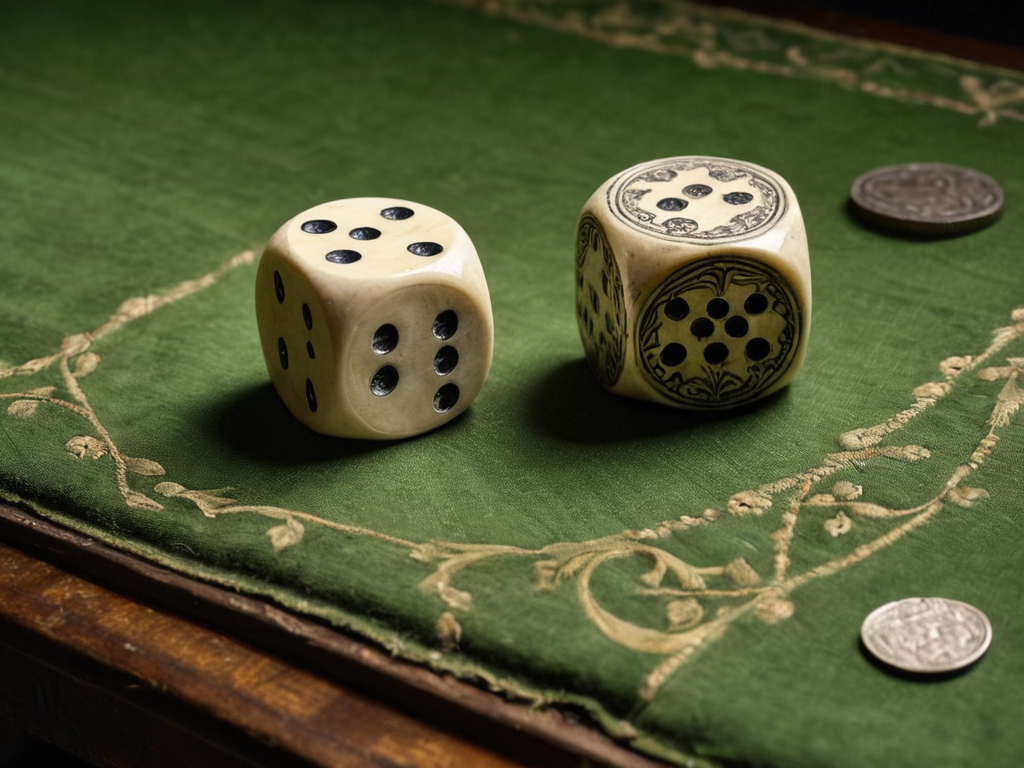
Before Cardano, chance was a mood. Fortune smiled at you or she didn't, and men prayed at the table. What he saw is almost embarrassingly simple once seen: a die has six faces, and before you bet, you can write all six down. Two dice: thirty-six ways. Three dice: two hundred and sixteen — he counted the whole circuit, as he called it, every door the next throw could open. And once the doors are written down, a bet stops being a feeling and becomes a fraction: the doors that favor you, over all the doors there are. Luck, turned into arithmetic. The first admission in history that the future comes in countable pieces.
Every win rate you will meet in this book — every "this spell works six times in ten in calm weather" — is Cardano's circuit, counted by the scrying pool instead of a goose quill. He is not one tool in the lab. He is under all of them.
Now cast it yourself, tonight, as a first spell. Take one trade you are merely considering — you may not take it; that is the vow — and write down its doors. Not the door you want. All of them: price reaches your target; price hits your stop; price gaps past your stop while you sleep; price chops sideways until you leave out of boredom. Four doors, most nights. If you cannot list the doors, you do not have a bet — you have a wish wearing a bet's clothing. Cardano's whole spell fits on one line: count the faces before you throw.
And copy out the last sentence of his gambling book, the most expensive sentence he ever earned, bought at a loss a day for twenty-five years: after all the counting, he concluded that the greatest advantage in gambling lies in not playing at all. Keep it somewhere safe. Four hundred years from this table, a chain-smoking Texan at seat twenty will reach the same sentence from the other direction, wearing algebra — but that is his chapter.
The Honest Ledger
Every guest at this table gets one. Labels are the house law.
Verified: the medical fame and the Scottish house call; twenty-five years of daily play, confessed in his own autobiography; the squandered inheritance; the Inquisition arrest in 1570, with the horoscope of Christ prominent among the accusations (the exact charges never fully surfaced — even his trial kept a card face down); the recantation, the lost professorship, the papal pension after. And this, the fact that should make you clench your fist: On Games of Chance stayed in his drawer. It was printed in 1663 — years after his death, and nine years after the two Frenchmen at seat six reinvented everything in it by mail. The first man to see chance clearly told no one in time. His losses bought the lesson; the drawer ate it. Let that be this seat's second spell, free of charge: an unwritten rule dies with its keeper. Write yours down.
His own telling: the Venice knife incident. Nobody was there to verify it but the cheat, who left no memoir.
Legend: the predicted death date, kept by force of will. Too neat to be true; too Cardano to leave out.
Measured, in this lab: nothing bears his name alone — because everything uses him. Counting the faces is a law of magic here, not an entry signal: you cannot buy bread with it by itself, and not one spell on the wall of this hall could have been tested without it. Every fraction in the lab's ledger was counted his way.

For Your Grimoire
The future is a set of doors, not a hallway. Count every door before you bet — and remember that the man who counted best concluded the surest edge is sometimes not to play.