The Man Who Weighed the Purse
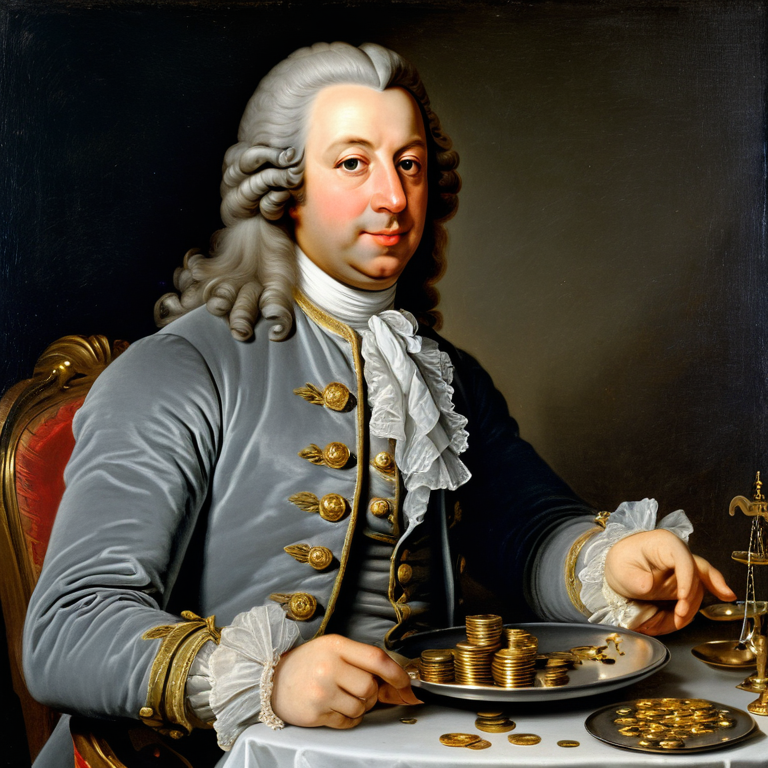
The quietest guest at the table, from the loudest family in the history of mathematics. He carries no dice and no tickets — only a small brass scale, and what he weighs on it is you.
---
The Seat
Seat ten holds a mild-looking professor from Basel, on the Rhine, and I will tell you first about his household, because it explains everything.
Daniel Bernoulli was born into a family so crowded with mathematical genius that it feuded with itself for lack of worthy rivals. Ordinary dynasties quarrel over land, or money, or the good silver; the Bernoullis of Basel quarreled over theorems, and collected academy prizes the way other families collect grievances — frequently both at once. His own father shared a grand Paris Academy prize with him — and banned him from the house for the insult of tying. That story is reported in every standard account of the family, and instantly believed by everyone who has ever had a father. But understand what a household like that trains into a boy, because he brings it to my table tonight: the settled certainty that any claim spoken over dinner will be checked, by somebody, before the soup is cold. Watch him among the other guests and you will see the reflex still running. He does not argue with them. He weighs them. The little brass scale sits beside his plate the way other men keep a pocket watch, and he has not touched the wine.
Daniel held, at the time that concerns us, the university's chair of anatomy and botany — the era winks at us — and from that unlikely desk he published, in 1738, the deepest page ever written about risk.
To feel the weight of that page, you must first see the world it landed on, and the world was betting — everywhere, enormously, and blind. In the salons of Paris, gambling was practically a profession of the well-born: dice and cards by candlelight, fortunes crossing the table while the wits traded epigrams over the players' shoulders. By day the whole age wagered in costume. Crowns sold annuities — hand the treasury a lump of money now and it pays you an income until you die, a bet on your own lifespan with the state across the table — and for generations the annuity cost about the same whether the life being bet on was a child of ten or a man of seventy, because the sellers simply did not know how to tell the difference in money. In the ports, merchants bought insurance on ships and cargoes at rates set by custom and haggling. Lotteries filled the treasuries of kings. An entire civilization stood up to its neck in chance, and chance had no arithmetic: every bet on earth was priced the way you priced your first trade — by feel, by fashion, by what the last person paid.
The arithmetic came late, and it came by relay — a torch passed hand to hand across nearly two centuries, and every hand that carried it got burned. An old Italian physician-gambler had counted the faces of the dice long before anyone else thought to, then left the book in a drawer; it was not printed until after his death, and the world had to invent it all again without him. Invented again it was, in a single Paris summer, by post: a salon gambler carried an old quarrel about an interrupted game to Blaise Pascal, Pascal wrote to a judge in Toulouse who did mathematics in the evenings the way other men garden, and the letters that traveled back and forth that season — weeks on the road each way — carry the birth certificate of every price you will ever see on a screen. Their rule: weigh every future by its chance, then add, and that weighted sum is what the bet is worth now, before fate chooses a branch. Then the torch nearly dropped once more — that same November, Pascal had a shattering religious vision in the night, sewed his account of it into the lining of his coat, and turned his life toward God, largely leaving mathematics behind. Others picked the arithmetic up and carried it into the counting-houses: a Dutch statesman priced his state's annuities by survival chances; an astronomer built a table of human mortality and priced lives by age at last. You have heard the fuller tale at seat six; I retell its spine here because the mild professor beside me is its heir. By the time Daniel sits down at his unlikely desk, weighing futures by their chances is no longer a parlor trick. It is the finest instrument civilization owns — and it is about to give an answer so plainly mad that it will take a Bernoulli to break it in order to save it.
He wrote his page to answer a monster, and the monster was a family member's — of course it was; in that family even the monsters were kept in-house. His cousin Nicolas had loosed it on the world's mathematicians in 1713: a simple coin game. Toss a coin until heads appears. Heads on the first toss, the game pays one coin. On the second, two. Third, four — the pot doubling with every toss, without limit. Question: what should you pay to play? The learned world came to know the little beast as the St. Petersburg problem, and it has kept the name, and its teeth, for three centuries. Notice how cheap the monster is to build: one coin, one rule, a child's game. The most dangerous problems in this book all share that trait. They cost nothing to state and everything to answer.
Now, the spell from seat six — weigh every future by its chance, then add — was by then the pride of the age. Cast it on the coin game and it returns its answer with a straight face: infinite. Every doubling future adds the same small slice, and the slices never end. The brand-new arithmetic of chance says you should sell your house, your horse, and your boots for one ticket.
And you wouldn't. Nobody would. Bernoulli noted, dryly, that any sensible person would happily sell this "infinite" prospect for about twenty coins. Savor the shape of that sentence — it may be the driest joke in the history of mathematics, and he does not appear to have been joking. When the finest formula of the century gives an answer every child can see is madness, something true is missing from the formula. A lesser mind defends the formula and blames the children. Bernoulli believed the children. Finding what was missing is why he has a seat here.
And mark where he went looking, because the address is half the lesson. He did not find the flaw in the game — the game had been analyzed to perfection; that was the whole scandal of it. He found what was missing in the player: in the purse, the household, the life that has to absorb the outcome. I like to think Basel taught him that. It is a city of burghers and ledgers, and if you walk it at dusk along the Rhine you can watch the windows going gold one by one — each candle somebody's evening arithmetic, a household totting up what came in, what went out, and what a bad year would do to them. Daniel asked of the grand salon arithmetic exactly the question every Basel household asked of its own accounts: very well — but what would it do to us? The deepest page ever written about risk is, underneath the mathematics, a piece of household bookkeeping. Which is why the quietest guest at my table unsettles the flashier ones. They came with stories of what they won. He came with a scale — and the scale asks only one question, and it is about you.
The Spell
Here is his repair, and I want you to feel it in your own purse.
A bet is not worth its pot. A bet is worth what the pot does to your life — and that depends on who is holding the ticket.
His own example, better than any formula: a poor man holds a lottery ticket that pays either nothing or twenty thousand gold coins, even chances. Seat six's weighing says the ticket is worth ten thousand. Is the poor man a fool to sell it for nine? No — he is right to, and the rich man who buys it from him at that price is right too. The same coin flip is worth different amounts to a beggar and a king, because a coin gained matters less the more you have — and, turned around, this is the blade — a coin lost matters more the fewer you have.
Follow the blade one more inch, as he did. If losses cut deeper than equal gains soothe, then betting a large share of your purse is poison even when the game favors you. Win, lose, win, lose in a fair rhythm, and a purse that bets big shrinks anyway — because the loss is always taken from a fuller purse than the win is added to. How much of your purse rides on one throw is not a detail of the bet. It is part of the bet's worth. A good game, oversized, is a bad game. Every word anyone will ever say to you about position sizing descends from that page, written by a professor of botany, answering his cousin's monster.
So his spell is a question, and you cast it before every fight: what does the losing streak do to me? Not the losing trade — the streak, because streaks are what real books are made of. Cast it tonight as a rite, with a pencil: write down your risk per trade in dollars, then write what your account looks like after ten losses in a row. Then fifteen. Then twenty. Somewhere down that column your stomach will speak. Size so that the answer, even at twenty, is: nothing fatal. Then read the ledger below, and see what twenty looks like in the wild.


The Honest Ledger
This seat carries the heaviest receipts at the table, because my lab put his blade to the modern test directly. The instrument is called `ruin.py`: it deals twenty thousand simulated trading lifetimes per book, from real recorded trades nobody cherry-picked, with honest costs left in.
Measured — the streaks are real. Healthy, ordinary spellbooks ran losing streaks of 16 to 22 in a row. Not broken books; not cursed wizards. That is what ordinary looks like when you deal enough lifetimes, and it is longer than most traders' nerve or arithmetic has budgeted for.
Measured — and corrected, which matters more. The lab once believed the worst streak was 67. It turned out we had accidentally shuffled many different books' trades into one pile and counted the pile — an honest mistake that flattered the drama. The true single-book number is the 16 to 22 above: still brutal, still enough to break most people, and true. The correction stays in the ledger on purpose. Even careful people fool themselves; checking is what separates a wizard from a mark.
Measured — the finding that ends the chapter. We went hunting for the bet size small enough to make a no-edge book safe. There isn't one. To keep the worst lifetimes merely bruised — inside a one-tenth drawdown — the risk per trade had to shrink to between $5 and $75 on a $50,000 account, which is not trading, it is pretending, with commissions. Bernoulli's blade, arriving at its terminus: sizing buys time; it never buys survival. Small bets give you more throws — and more throws of a game without an edge reach the same cliff by a longer road. Size protects a good book. Nothing protects a bad one — except the honest work of making it a good one, which is what the rest of this book is for.
Measured — the ward sometimes fails. The worst single trade in the record cost −3.58R where the stop promised −1. Gaps go through walls. A stop-loss is a ward, not a law of nature; size as if it will mostly hold, never as if it always will.
Verified (biography): the 1738 paper and the 1713 cousin's monster; the twenty-coins remark; the beggar-and-king ticket example; the chair of anatomy and botany. Reported: the household ban over the shared prize — family legend of the best kind, sourced to every standard biography and disputed by no Bernoulli on record, possibly because they were not speaking to each other.



For Your Grimoire
Before you ask what the winning trade pays, ask what the losing streak does to you. Size so the answer is "nothing fatal" — and remember that no size at all can save a book without an edge.