The turtle rule cast in trending weather — it earns its keep.
☶
Magic in the Markets
Adventure · Visit XII · The Pits, 1983–1987
The Pits
The loudest room in the history of money — and every edge in it was made of writing.
♪ Rulebook Pulse · the music of The Pits, 1983 · MoneyWizard
The loudest room in the history of money. I went in expecting the master of this era to be the loudest man in it, and I was wrong three times: the lessons of the pits were a rulebook in a beginner's hands, a trophy with a storm hidden inside it, and four words written in black marker on a sheet of loose-leaf paper.
The step through
Every door on this journey has had a sound on the far side. The olive presses creaked. The tulip tavern hummed. The rice bridge at Dōjima clattered like rain on a roof. The dancer's era was the strangest — the sound of his market was an ocean of silence he built on purpose.
This door has a roar behind it before I even touch the handle.
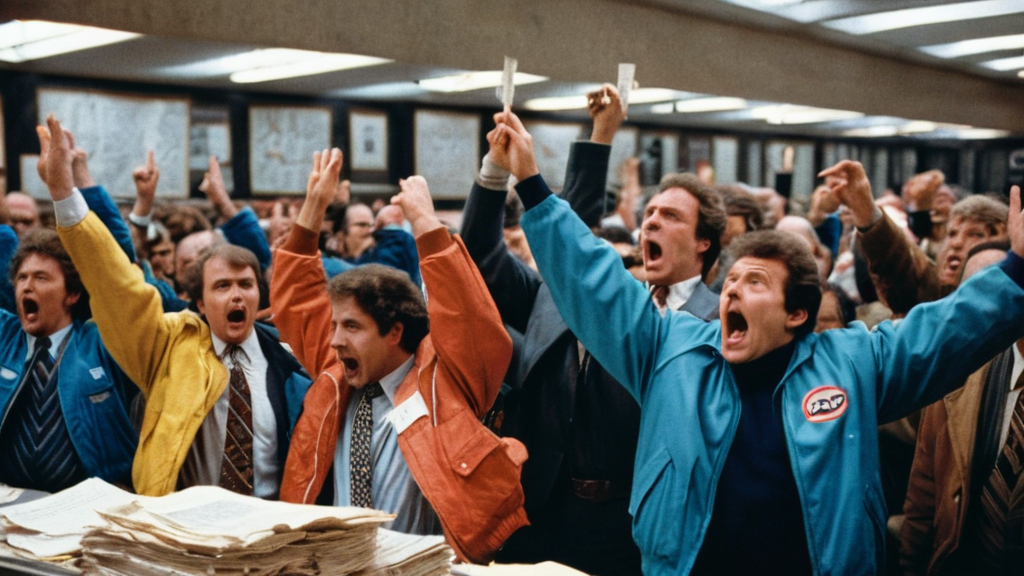
Chicago, 1983. I step through onto a balcony above a sunken octagon of steps, and below me are hundreds of men in colored jackets, packed shoulder to shoulder, screaming numbers at each other with their whole bodies. Palms push outward, palms pull inward, fingers flash counts — a language of hands riding on top of a wall of voice, because down there the voice alone stopped being enough long ago. There is no ticker being worshipped here, no ribbon of paper. The price is not being reported in this room.
The price is being made, by throat.
They call these arenas the pits, and for one last decade they are the beating heart of the world's futures markets — grain, bonds, currencies, the price of next year traded by men standing on steps so everyone can see everyone's hands. I have stood in storms on this journey. This is the first one made entirely of people.
And the folklore of this floor, which every jacket down there believes the way sailors believe in weather, says one thing above all: this cannot be taught. You have it in your blood or you don't. The pit finds you out.
Naturally, that is the belief this era exists to break.
The market of that age
Understand what is balanced on a knife's edge in this decade, because it makes every lesson here sharper.
The pits are at their absolute loudest — and they are already dying. In the corners of the buildings, in offices above the floor, a new creature has arrived: the screen. Green numbers on dark glass, prices from everywhere, updating without a single human throat involved. Almost nobody in the octagon takes it seriously yet. The screen does not sweat, the jackets say. The screen has no blood. The screen, for its part, says nothing — which should have worried them more than it did.
So the era splits in two, and I spend this visit climbing between the halves: the loudest trading room ever built, and the quiet rooms around it where three different masters are, in three different ways, writing things down. That is the whole shape of this chapter, so I will say it plainly before we start walking:
In the loudest room in the history of money, every edge I found was made of writing.
The novices with the rulebook
The first quiet room is a classroom, and it should not exist.
Its owner is Richard Dennis, a Chicago floor legend — the winnings the pit folklore hangs on his name are legend, and I leave them in the folklore where they live. What the ledger holds is not the fortune. It is the experiment, and the experiment is the treasure of this whole city.
Dennis had heard the pit's oldest sermon — blood, not books; you have it or you don't — and he decided it was wrong, and he decided it the way a wizard should: he bet on it. (In Chicago, betting on your beliefs is not a metaphor. It is the municipal pastime.) The famous version says the wager was struck with a fellow master over whether trading was a gift or a craft; the versions disagree on the details, so I take only the part every version agrees on, which is what he actually did. He advertised for people who had never traded. Ordinary people — beginners, novices, the exact people the floor said the market would eat. He sat them in a room, handed them his method as written rules — a breakout method, kin to Donchian's channel from the 1960s: when price climbs out above its recent high ground, go with it — and then, the story runs, he staked them with his own coin and set them loose.
The class got a nickname: the Turtles. Why turtles? The legend gives several answers and the ledger gives none, which by now you know is this book's way of saying enjoy the story, trust the ink.
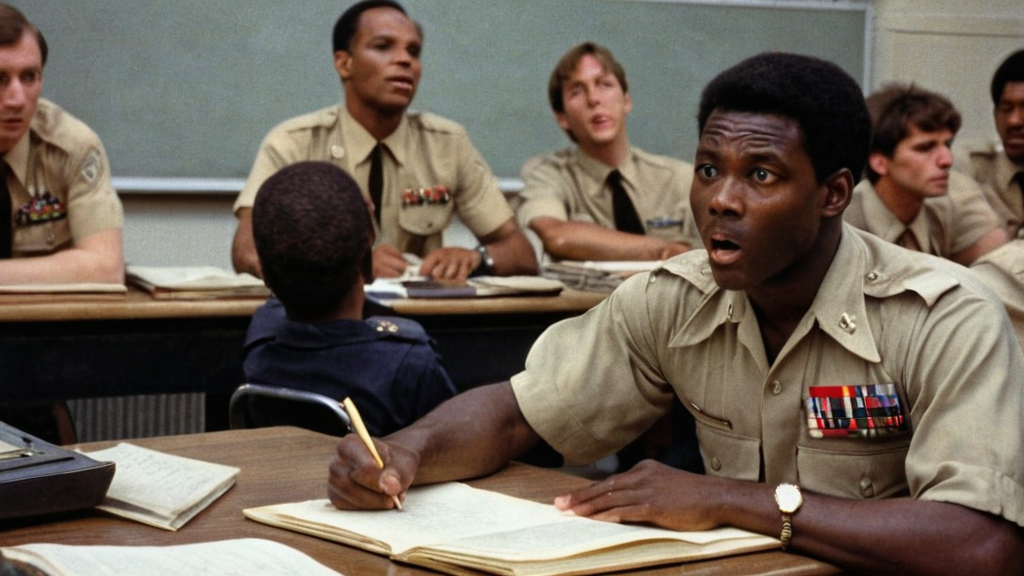
Here is the surface lesson, the one the newspapers of that era could have printed: the novices with the rulebook did well enough to settle the bet. Rules beat blood. The craft could be taught — which means the sermon of the pit was not a law of nature. It was a fence, and a man paid to have it torn down in public.
But stand in the classroom a moment longer, because the deeper spell is quieter and it is the one I carried out of Chicago.
Ask yourself what a written rule actually is. On an ordinary day, it is nothing — a sentence you would have followed anyway. Its whole value is concentrated in one kind of day: the day the storm is up, the account is bleeding, and every instinct you own is screaming. On that day your nerve — the blood the pit worshipped — is the first thing to desert you. Ink does not desert. A written rule is courage stored in advance, the way a candle is fire stored in wax. Dennis's novices could hold through days that broke veterans not because they were braver, but because the decision had been made earlier, by a calmer person, and written down where the frightened person could find it.
That is why the rulebook is the first treasure in this chapter's pack. And now I will break the order of my own story, because I cannot resist telling you what happens when this exact rule finally reaches my scrying pool at home, in 2026, under a measured sky.
40.1%wins in clean wind
15.0%wins in chop
The same rule, same ink, same sentences — cast into chop, it starves.
Same spell. The weather is the only difference.
Hold both halves. The Turtles proved the rule can be written and taught. The pool proved the rule was never the whole spell — the weather it is cast in is the other half, and nobody in 1983 was reading weather. That missing half is where this whole journey is headed.
The cowboy and the terminal
The second quiet room barely qualifies: it has a green-glowing terminal in it, and a man from Montana wearing the kind of confidence the pits respect.
Larry Williams has been at this since the 1960s — he built an oscillator in 1966 that still carries his name, and he was reading the public reports of what the biggest players held decades before that was fashionable. He wrote books with loud claims right on the covers, and I give you the label before the legend: a book cover is not an audit. Nothing on a dust jacket in this chapter is verified. The era liked its book covers the way it liked its trading jackets: loud.
Which is exactly why what happens in 1987 matters so much.
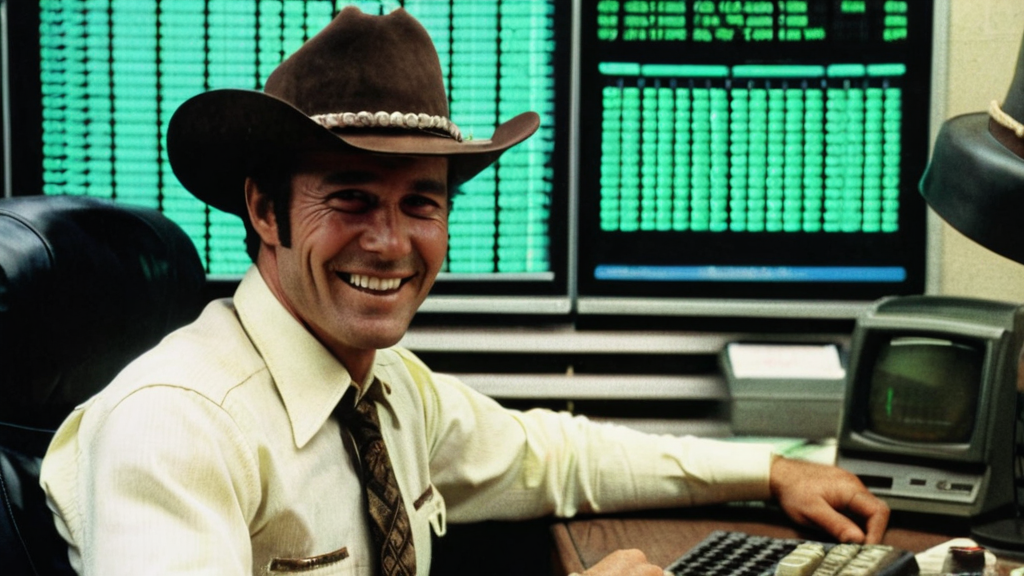
That year Williams enters a real-money trading contest — an actual brokerage account, scored on its true statements over twelve months, examined by outsiders. Not a story. A ledger, the genuine article, the rarest object in this entire book. He starts with $10,000.
$10,000 → $1,147,607
one contest year · audited endpoint · 1987
Verified. The records were reportedly examined by regulators out of sheer disbelief, and the records held. Nothing on that contest's honor roll has come near it in the decades since. It is, as far as I can tell, the single most spectacular audited year in this whole journey — centuries of legends, and the wildest number that survives checking belongs to a man in a cowboy hat at a green screen.
Now here is the part the trophy engraving leaves off, and this book exists to put it back on.
The endpoint was audited. The road was not — the middle of the story comes from tellings, not statements, so wear the REPORTED label on everything in this paragraph. Mid-contest, the account is said to have climbed past two million dollars. Then October 1987 arrived — we will stand inside that October shortly — and in the storm the account was cut to roughly three-quarters of a million. More than half the tower, gone in the gale. And then — this is the part I want you to keep — he kept casting. The rules were still rules. He traded the account back up and crossed the finish line at the audited number with the trophy in his hands.
He was risking, by the reported accounts, on the order of a third of the account on a trade — the mathematics of maximum growth, which is also, by the same arithmetic, the mathematics of maximum drawdown. Williams himself later called that mode cowboy trading and said plainly that luck carried a large share of it. So take the lesson he himself offers: the endpoint is the trophy; the trajectory is the tuition. Contest sizing and survivable sizing are different animals wearing the same saddle. The same trades at sane risk make a fine year — not an eleven-thousand-percent year, and not a fall through the floor of the sky either.
A word on the man, because the register of this book is honesty: Williams kept score in public his entire life. Contests with real accounts. Rules published where anyone could test them. He even ran for the United States Senate twice — and lost both races, which I note only because it means the man submitted himself to more public, verified scorekeeping than nearly anyone else at this table. Among all the masters in my pack he is one of the least mystical: he wrote his patterns down as exact rules and sold them openly, which is precisely why my forge can do something with him.
And his spells travel home with me in writing. Two of them, exact enough to pre-register. The first: volatility expansion — a day that surges out beyond its recent normal range tends to keep going, so a buy order waits above the open by a fraction of yesterday's range, and a sell order waits below. The second he named OOPS — when the market gaps open below yesterday's low in a panic and then climbs back into the old range, the panic has failed, and you go with the snap-back. The name, I am delighted to report, is verified: it is what the broker says on the phone to the client whose emotional overnight order just went wrong — “oops.” An entire trading pattern named after an apology. The pits were not a subtle civilization.
Notice what he handed me, because even he said the weather mattered: one spell of pursuit and one spell of snap-back — fire and water out of the same saddlebag. Both sit tonight in my forge at home, written exact, pre-registered, awaiting trial. The pool has not yet spoken on either. When it speaks, the book will print what it says — that is the vow this book is built on.
The storm
Monday, October 19, 1987. The Dow falls 22 percent in a single day — the worst single day in the history of the American stock market, before or since.
I want to be careful here, because this book has stood inside manias and panics before and it keeps a rule: the storm is the setting, never the story. Nobody in this chapter drowns. What Black Monday is, for us, is the one day the whole era had been quietly preparing for — the day that found out, within hours, what every trader in two cities was actually made of. Not their brilliance. Their writing.
You have already seen the storm from inside it: Williams, cowboy-sized, watching more than half his tower blow down between breakfast and the close — and rebuilding from the rubble because his rules still told him what to do next. A storm survived, with the tuition paid in full and in public.
Now climb out of the pit with me, take the train to New York, and watch the same day from the other side.
Two phones and a paper sign
The third quiet room is not quiet at all — it only contains quiet things.
A young trader from Memphis named Paul Tudor Jones, raised in the cotton pits and running his own shop by thirty-two, is standing at his desk with a telephone in each hand, shouting into both. He is loud, superstitious, sneaker-shod, utterly alive. I know this not from legend but from film — a documentary crew had spent that year in his office, and the hour they aired that summer caught him exactly as he was. Years later, polished and respectable, he reportedly found the film so embarrassing he asked for it to be pulled from circulation — which of course made bootleg tapes of it trading-floor contraband for decades. The pit gods are not without humor: the man who mastered the market could not buy back his own footage.

Behind the two phones, taped to the wall, is the quietest thing in New York: a sheet of loose-leaf paper with four words in black marker.
LOSERS AVERAGE LOSERS.
Read it correctly, because it is a law about positions, never about people — no trader in this book is a loser, and that is not what the sign says. It says: when a position is moving against you, the market is handing you information, and adding to that position — averaging down — is paying more for the thing the market keeps telling you is worth less. Feeding a loser does not rescue it. It grows it.
Now, the famous story, and then the honest one — this book always tells both, and here they happen to be the same story wearing two faces.
The famous story: earlier that year, Jones's research man laid the chart of the 1920s market over the chart of the 1980s, and the two lines fit with an uncanny closeness — he claimed a number for the fit on camera, and I label it exactly that, his claim on camera, not a measurement. The overlay prophesied 1929 all over again. Jones positioned short. The crash came. His fund's October is one of the most repeated numbers in market folklore — roughly a 62 percent gain in that single month — and I hand it to you wearing its true label: REPORTED. The fund was private; its statements were never public; no audit of that number exists for anyone to check. The career around it is not in dispute. The digits are folklore until a ledger says otherwise, and none ever has.
I claim my one question of this era standing in that office with the crash roaring in both his phones: how did you know?
The honest answer arrived years later, in print, from the research man himself, and it is the finest gift this era gave me. He admitted he had fudged the exercise — juggled the starting points of the two charts to make the lines lie down together. And the sculpted prophecy's clock was broken besides: it called for the break in the spring of 1988. The market fell in October 1987. The most famous market prophecy of the modern age was a hand-fitted chart that was wrong about the date.
So what actually paid?
The dull things. The taped-up things. First: the market had already fallen below its 200-day line — the average of the last two hundred days' closing prices, the long slow line a chart carries like a keel — and Jones's stated law, the one he repeats to students to this day, is that this line is his metric for everything, and its purpose is defense: above the line you play; below the line you defend. He was carrying nothing on the long side at the top, not because a prophecy told him, but because the keel-line forbade it. Second: the sign. No losing position ever got fed. Third: his hunting rule — only take shots that pay 5-to-1, five dollars of intended reward for every dollar risked, because at those odds a hunter can be wrong four times in five and still walk out whole. He says it himself: wrong 80 percent of the time and still not losing.
Defense, discipline, asymmetry. The prophecy made the legend. The loose-leaf paper made the fortune.
And here my pool at home has already rendered its verdict, so I give it to you out of order once more. I carried the 200-day line back to 2026 and cast it both ways. As a trigger — buy when price crosses the line — it measured out to nothing, which matches what Jones actually said: he never claimed the line picks entries. But as a gate — a permission, a rule that simply forbids playing on the wrong side of the keel — it improved four of the four tools it guarded. Every single one. The oldest, dullest line on the chart, doing exactly the job the man with two phones said it does: not prophecy. Defense. The pool and the pit agree, and when those two agree, write it in ink.
The lesson taken
Now the ledger — three treasures out of the loudest room, every one of them silent.
The rulebook. Trading can be written down and taught; the pit's blood-sermon was a fence, not a law. And the written rule's true power is concentrated on one day: the day your nerve fails. Ink is courage stored in advance. But the pool adds the half the era could not see — same ink, 40.1 against 15.0 — a rule without its weather is half a spell. Remember that; the next door hangs on it.
The trophy and the tuition. One year, one account: an audited endpoint worth engraving, and a reported road through it that fell more than half and climbed back. Both halves are the lesson, and this book refuses to teach one without the other. The trophy says the spells were real. The tuition says contest sizing and survivable sizing are different animals — and only one of them is for you.
The paper sign. The famous prophecy was fudged and mistimed, by its own maker's admission — and the fortune happened anyway, built from three dull disciplines any apprentice can copy tonight: stand on the right side of the 200-day keel, never feed a losing position, and only take 5-to-1 hunts. When the most spectacular trade of the modern age turns out to be made of defense, believe the defense.
And notice, one last time, the joke the loudest room played on itself. Voice was the whole religion of the pits — and not one of these three edges was made of voice. A written rulebook. An audited statement. A marker sign. The men screaming in the octagon were magnificent, and the future belonged entirely to the quiet things at the edges of their noise.
The step back
Evening. The floor below the balcony is ankle-deep in torn paper — the confetti of a million settled arguments — and the jackets are streaming out toward the bars, hoarse and alive. In the offices above them the green screens glow on, unbothered, needing no throat.
The pits do not know it yet, but the roar has begun its long fade. The next door does not open onto a floor at all.
It opens onto a corridor of quiet rooms — chalk dust, blackboards, machines that hum instead of scream — where a new kind of wizard is asking the exact question this visit left on the table. The Turtles proved the rule; the pool proved the rule needs its weather; and somewhere past 1988 there are people learning to measure the weather itself — to put a number on whether the wind is clean or the water is chopped, and to let that number choose the spell.
The choosing. The one magic no era has yet owned. The chalkboards are where its first true instrument gets forged, and I intend to be standing there when it happens.
Step through with me. The roar dies behind the door, and somewhere ahead a piece of chalk is beginning to move.