The Costumed Debt
The strangest stop on the whole journey: a market with no master, because the master is the market — a fugitive gambler who dressed a nation's debt as shares, printed the money that priced them, and taught me the one question no green number on your screen will ever answer for you: counted in what?
The step through
I arrive into a noise I have never heard a market make.
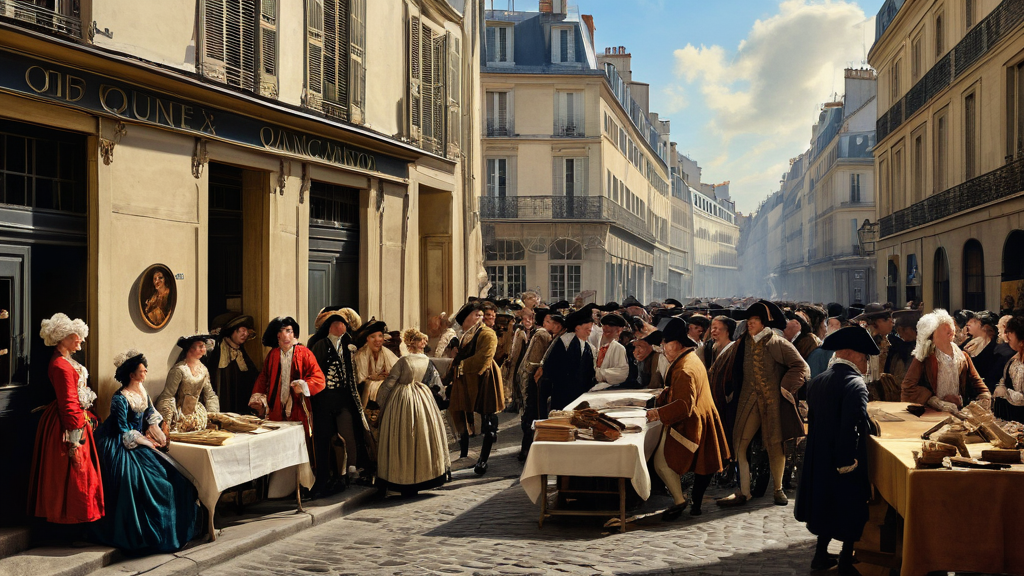
Paris, the first days of 1720. Every other floor I have visited roared — the tulip taverns, the courtyard with the canal under it, the rice bridge at dawn. This is not a roar. It is a scream with commerce inside it, and it is coming from a street.
The rue Quincampoix is an alley, really — a slot between tall houses in the merchant quarter, built for handcarts and gossip — and this winter it is the financial center of the world. The crowd is packed wall to wall from before light until the soldiers clear it at night: dukes pressed against their own footmen, bishops, widows, pickpockets, and country lawyers all shouting the same word, which is the name of a company. Sedan chairs cannot get through. People have died in this crush — not in a panic, understand. Died buying.
The air smells of mud, perfume, tallow, and fresh ink. That last one matters. Remember the ink. Nearly everything in this chapter is made of it.
The market of that age
Understand what is being traded in that alley, because it is not what any market before it traded.
France in 1715 was the grandest kingdom on earth and it was broke. The old king had spent seventy years building palaces and fighting everyone, and he died owing sums nobody could sensibly write down. The King's IOUs — his promises to pay — changed hands at a deep discount, because nobody believed them. That is an old, honest kind of market: a promise, doubted, priced accordingly.
What trades on the rue Quincampoix is something new. Two papers, twinned.
The first paper is a share in the Mississippi Company — a claim on Louisiana, a French territory across the ocean said to be stuffed with gold, furs, and tobacco. The company has swallowed, one by one, France's other trading companies, its tobacco monopoly, its mint, its tax collection — until this one company is, more or less, the commerce of France.
The second paper is money itself — banknotes, a marvel of the age. Instead of hauling silver, a Parisian carries a printed promise from the Royal Bank. Lighter, cleaner, faster. Within a couple of years the notes are not a substitute for the money. They are the money.
Now the detail the whole chapter turns on: both papers come from the same man. The company that sells the shares and the bank that prints the money have one author, one architect, one will. We will meet him in a moment.
First, the street, because its scenes became legend, and this book owes you its usual honesty about which is which. The mania made landlords of everyone — rooms on the rue Quincampoix rented for fortunes; that much is documented. Then the legend, from Mackay — a Scot who collected the great manias into a famous book in 1841, more than a century after the fact. Mackay says a cobbler made a second fortune renting out his stall and writing materials to speculators. And Mackay says a hunchbacked man grew rich renting out his hump — as a portable writing desk, for traders with a deal to sign and nowhere flat to sign it. Historians wink at the hunchback; he is probably as real as the one at Notre-Dame. But notice what the wink cannot dismiss: Paris told that story at the time, and Paris believed it. A market where that story sounds plausible is a market past appraising — the legend is false and the measurement is true.
And one verified fact, to my ear the funniest of the age: the speculators of this street got so rich, so fast, that the French language ran out of words for them and had to mint a new one. The word was millionnaire. It was born here, in this alley, in this mania. Every time you hear it, you are quoting the rue Quincampoix.
The master — the system in a silk coat
In every other era I sought out a master: a watcher, a poet, a rice trader on a hill. Here I went looking for one and found something stranger. The ablest mind in this market is not in the market. He is the board it is played on.
His name is John Law, and I will give you his story straight, because no novelist would dare invent it. Born Edinburgh, 1671, to a family of goldsmiths and bankers — the boy learned the family arithmetic and took it somewhere the family did not intend. In London, young and vain, he killed a dandy in a duel — one thrust — was convicted of murder, sentenced to hang, saw the sentence softened, was held in prison anyway, and escaped. What the duel was about is one of history's shrugs; the old accounts disagree, and the ledgers say less than the legends do. What is documented is that for the next twenty years he was the best-dressed fugitive in Europe.
He lived by gambling — and here my lantern swung, because I had sat with the men who invented the arithmetic of chance, and Law is their dark graduate. He did not play for luck. He calculated faster than the tables, took the side of the odds, and banked. And between games he studied — the great Bank of Amsterdam among his subjects; he had walked, I would wager, the poet's own courtyard — and he wrote pamphlets arguing an idea a century ahead of its hour: that a country's problem is never too little gold, but too little money, and that paper, properly managed, could be better money than metal. Scotland turned him down. France, magnificently, did not. The new Regent knew Law from the gaming tables and was desperate, and so — savor this — the kingdom of France handed its money to a convicted killer on the run from English justice. The eighteenth century was not a cautious age.
What Law built, I can teach you as three gears, because it is not one trick.
Gear one: make the paper. His bank issued notes you could, in principle, swap back for coin. People preferred the paper; soon the paper was the money; and whoever runs the printing press now decides how much money exists.
Gear two: swap dead debt for live hope. The company sold its shares priced at face value — payable in the King's discounted IOUs. Holders of doubted paper traded it for a piece of Louisiana's glorious future; the state got its debts consolidated cheap; every ledger in France looked instantly healthier, and not one bushel of tobacco had been grown. The national debt was not paid. It was costumed — dressed as shares and sent to the ball.
Gear three: the loop. The costume only works while the shares rise. So when they wobbled, in the spring of 1720, Law did the thing no market had ever seen: he had the bank decree a floor, standing ready to turn any share into freshly printed notes, on demand, at a price fixed near the top. Say it plainly: the man selling the stock also printed the currency it was priced in, and used the press to be the buyer of last resort of his own shares. The share price could not fall — and precisely because it could not fall, it stopped meaning anything. A price you are not allowed to disagree with is not a price. It is a decree wearing one.
I got near him once — Controller-General of Finances by January 1720, the gambler now running the treasury of Europe's greatest kingdom — and I asked my one question, the only one I thought a gambler would respect: what odds does the house keep against the day they all want out at once? He gave me no answer I can quote — I invent no man's words. But his published papers answer for him, and I paraphrase them honestly: a rich country is a country with money enough to move its trade, and confidence is the metal that backs it. He was not lying. That is the terrible part. The scheme's author was its truest believer — he kept his own fortune in it to the end, which no simple thief does — and I walked out of that room having learned that the most dangerous man in any market is not the one who fools you. It is the one who has fooled himself, and prints.
The year the money broke
Here is what I witnessed, and the ledgers back all of it.
The shares had risen twentyfold inside a year. Cooks and coachmen were buying carriages; the new word millionnaire was doing heavy work. And under the floor of it, the press ran, because gear three demanded it: every share brought to the bank became fresh notes, and the notes poured into the streets, and the streets answered the only way streets can — bread cost more, then everything cost more, roughly doubling, and Paris celebrated its paper riches in a currency quietly rotting in its pocket.
One man in that crowd kept his sight. An Irish banker named Richard Cantillon looked at the machine and reasoned where the pressure had to go: the floor under the shares forced the printing, and the printing had to break the money. So he made the one honest trade left in the whole system — he stopped betting on anything priced in livres and bet against the livre itself, selling early, moving his wealth into other countries' money and claims that Law's press could not touch, and standing so that the weaker the French paper grew, the richer he got. Everyone on the rue Quincampoix was measuring their fortunes in a unit one man could manufacture. Cantillon measured in units nobody in France could print. He is the only person in this chapter who leaves it wealthy.
In May 1720, Law himself tried to step the machine back — an edict walking the peg down, devaluing the notes by stages, an architect trying to ease his tower to the ground. The tower's only material was confidence, and confidence does not come down by stages. It evaporated in a day. By July, crowds besieged the Royal Bank trying to turn paper back into anything real, and people were crushed to death at its doors — more than a dozen on one morning, the reports say. Buying at the start of the year, dying to sell at the end of it: same street, same crowd, same paper. By autumn the notes were stripped of their value by the same authority that had conjured it. In December, Law fled France in disguise, his fortune confiscated, carrying — the legend says — little more than one good diamond.
He ended where gamblers end: Venice, playing small stakes where he had once moved nations, and died there poor in 1729. And France was so burned that the very word banque stayed poisonous for eighty years — no national bank again until Napoleon. A whole language flinching at a word: that is the crater this chapter stands in.
The lesson taken
Home, to the pool, with the strangest relic of the journey: not a tool, a warning label.
Every stop before this one taught you something about the top of a price: what a promise is worth, what a crowd's weather does, when to take the goblin treasure. Paris taught me about the bottom of the fraction — the unit the price is counted in. A price is a ratio, and the bottom of a ratio can rot. A trader on the rue Quincampoix who was up twentyfold was rich in livres — a unit being manufactured, that year, by the very man whose asset he held. Everything he owned lied to him in the same voice, and no one holding livres could see the crash coming in livres. The only instruments that told the truth in France in 1720 were the ones Law could not print. So: check your denominator. When the money itself is the bubble, everything priced in it lies — and if the seller of the thing also mints the unit it is measured in, or promises you a floor conjured from nowhere, you are not watching a price anymore. You are watching theater with numbers in it.
And the pool, when I poured this era into it, added the cold arithmetic underneath — the one measured truth I brought home, arriving at the end, alone, the way the heaviest things should. The lab has tested it every way we know how: there is no safe size for a losing book. No cleverness of sizing rescues a system that loses on average; scaling it up only scales the ending. Law's whole kingdom-sized machine was that theorem staged with a country. His book was losing from the first debt-for-story swap — Louisiana was swamp and mosquitoes; the earnings were never coming in time — and every note he printed to defend the peg was a size-up on a losing position. The gambler who had always taken the side of the odds finally sat down, as the state, on the wrong side of them — and doubled, and doubled, and doubled. Sizing up did not save his trade. It only made the ending national instead of personal.
You will never run a country's press. But you have felt the small version in your own hands — the urge to defend a bad position with more money, to build a floor under your own mistake. Paris is what that urge does when nothing stops it. Nothing about it changes with size except who pays.
The step back
I leave through the alley at night, after the soldiers clear it, when the trampled papers show pale against the mud — shares, notes, promises, yesterday's fortunes — all of it ink.
A nation's debt in costume was the sickness here. But debt itself was never the villain — and the door opens next on a nation's debt worn honestly: traded in the open, in a members' hall in a fogbound city, its price rising and falling on one question — how goes the war? A century after Law bet a whole kingdom on a single position and printed to defend it, another man will stand on that fogbound floor in the worst week of rumor of the age — the fate of Europe on a battlefield no one can see — and he will be the calmest man in the room. Not because he knows the outcome. Because of how he is sized. He is everything Law was not — and the legend they tell about him afterward gets everything backwards.
Step through with me. London, 1815.