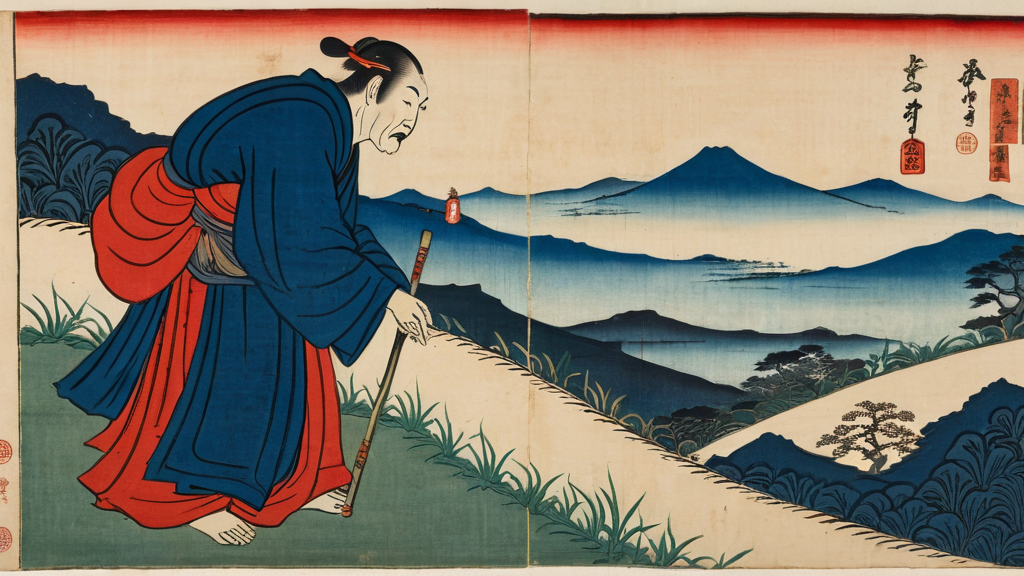
Fire in the Rice
The world's first futures exchange, and not one grain of rice in sight. Mind the buckets — this market has to be put out like a fire, every single day.
The step through
The door opens onto a bridge at dawn, and the past smells like breakfast.
Woodsmoke and river water, tar and straw, and under all of it, everywhere, the warm dusty sweetness of rice — rice in bales, rice in boats, rice worked into the boards of the bridge I'm standing on. Below me a brown river slides between stone banks, already crowded with barges riding low under matting, and on both shores the warehouses go on and on, white-walled, roof after roof, like a snowfall that decided to stay.
This is Osaka, and the whole country calls it the kitchen of the realm, because everything Japan grows comes here to be turned into money. I pull the hood down and join the men already gathering on the bridge — sharp-eyed, quick-sleeved men, none of them carrying anything heavier than paper.
Remember that detail. It is the whole chapter.
The market of that age
To read this market you need one strange fact first: this country runs on rice the way yours runs on money. Taxes are paid in rice. Lords measure their wealth in rice. The samurai — the entire warrior class — draw their yearly salaries in rice. A man's income is spoken as so many bales, and a bale of rice is a paycheck you can eat.
So every autumn, the harvest of a hundred provinces floods down to this one city, into those white warehouses along the river. And here the lords' agents discovered the first convenience: rather than lug bales to every buyer, the warehouse sells the rice at auction and hands the winner a paper ticket — bring this back whenever you like, collect your bales. The tickets are lighter than rice. The tickets move faster than rice. And so — quietly, the way water finds a crack — the tickets became the market. Men bought and sold the paper all day and left the bales sleeping in the dark.
Then someone sold a ticket for rice that hadn't grown yet. Next autumn's harvest, priced today. And once you can trade rice that doesn't exist, why stop there? By the time I'm standing on this bridge, the busiest trade at Dōjima — the rice market planted on this riverbank in 1697 — is in something the traders call, with perfect honesty, book rice: rice that lives only as writing in ledgers. Every deal the same size — one lot is enough rice to feed a hundred people for a year, and not a grain of it will ever be seen. Counting houses stand in the middle of every bargain so that no man need trust a stranger, the season's promises cancel against each other on paper, and whoever's promise lost pays the difference in silver.
No rice moves. Only prices, and money, and belief.
If your eyebrows just went up — isn't that gambling? — you are in excellent company: the shogun's government said exactly that, and banned it for years. Then the price of rice collapsed, the samurai found their rice-salaries buying half a living, and in 1730 the shogun blessed the very thing he'd been forbidding, in the hope that eager buyers of paper rice would lift the price of the real thing. The gamblers were legalized to rescue the soldiers. Markets have been getting rulings like that ever since.
Stand on the bridge and understand what you're looking at, because your own screen descends from this riverbank: promises standardized so any promise cancels any other, a house in the middle guaranteeing both sides, differences settled in cash, prices discovered by open shouting. The world's first futures market — a market in later, run on paper and nerve — and it is a market in the one thing everybody in the country must eat.
The fuse and the bucket
Morning proper now, and I want you beside me for the opening, because nobody warned me about the fuse.
At the ridgepole of the market building hangs a small wooden box, and in the box an official sets a slow fuse burning. That cord is the trading day. While it burns, the crowd below trades — and crowd is too calm a word. Hundreds of men packed shoulder to shoulder, shouting prices, flashing finger-signs over the heads between them, deals struck eye to eye across ten feet of roaring air. No tickets change hands out here. A shout and a sign, and a fortune in book rice has a new owner, and the ledgers will square it all by evening.
Then the fuse dies. The price at that moment is the official close.
And nobody stops.
They know the rule. The rule knows them. The shouting rolls straight on past the dead fuse — because somewhere in that crowd are men who are losing, and the day cannot end badly if the day refuses to end. So the exchange keeps a crew for exactly this, and I watch them come: the watermen, grim as firemen, buckets swinging. The first pass is a warning splash. The second is whole buckets, full in the face, water arcing over the crowd until the trading drowns — and the price being shouted as the water lands is the one written into the books. The fuse's price opens tomorrow; the bucket's price settles today.
Think of it. A market so alive it must be extinguished daily, by hand, like a fire. The records even complain of ruined traders charging the close on horseback to stall the reckoning — men trying to hold the door of the day open with their bodies. You have felt that exact wish at 3:59, and now you know how old it is.
And the moment the bucket falls, the price leaves the city. On rooftops and hilltops stretching out from Dōjima, men stand with flags half the size of a door, and the closing price goes waving from hill to hill, read by telescope, relayed onward — modern re-enactors with flags and clocks have run the old routes, and the price reaches Kyoto in about four minutes. Runners with sealed letters take days. The flags take minutes. The authorities banned the flag-men over and over; the flag-men kept waving. Fast information has never once in history stayed illegal.
Follow those flags north with me. At the far end of this country is a man who understood better than anyone alive what they were really carrying.
The master of Sakata
The ride north takes days — up through mountains, down river valleys, out at last onto the grey coast of the northern sea, where a port town called Sakata sits at a river mouth shipping the rice of the north country down the long sea road to Osaka. Six hundred kilometers from the bridge where we started. In this town, one merchant family looms over all the others, and its young master is thirty-one years old.
His name is Homma Munehisa, raised from boyhood inside the family rice trade, and I find him where the shipping agents of Sakata keep their watch — on the weather-hill above the harbor, where men read the sky to decide which ships sail. That much is ordinary; every port has its hill. What Homma keeps at the bottom of the hill is not ordinary at all: rooms of ledgers. Years of rice prices, set beside years of weather, kept and compared the way a scholar keeps texts. Where other merchants remember last season, he can look up the seasons from before he was born. He has built himself a memory longer than a lifetime — the first trader I have met on this whole journey to do it — and I know a scrying pool when I see one, even one made of paper.
The legends have reached even his doorstep ahead of me, so let me sort them in front of you, because this book's magic is that it doesn't lie. Legend says he strung a private signal line of men from Osaka toward Sakata — every few kilometers, on rooftops, with flags; some tellings say runners, some say fires; the tellings do not agree, which is itself worth knowing. The ledgers prove the flag-telegraph out of Dōjima was real; how much of a private line was his, the legend keeps to itself. Legend says he won more than a hundred trades in a row, that his fortune beggared princes, that the shogun's court made a samurai of a merchant in his honor. The records say less, and say it more quietly. They called him — this is attested — the god of the markets, and crowds in faraway Edo sang a street song about him: when the sun shines in Sakata, it clouds over at Dōjima and rains in the rice quarter of Edo. A weather system with a man's name.
I climb the hill and ask him my one question — yours, really. All of it — the ledgers, the weather-watch, the flags. What is it you are watching?
He doesn't point at the sky, and he doesn't point at the sea. His answer survives, because in this very year — 1755 — a small book comes out of Sakata that tradition puts in his hand: The Fountain of Gold — The Three Monkey Record of Money. And it is not a book about rice. It is not a book about weather. It is, so far as anyone can tell, the first book ever written about the minds of the people trading — about fear and greed moving prices, about the mood of the floor as a thing you can study. What he watches, over all those miles of flags and all those years of ledgers, is the other traders' hearts.
And in that book sits an idea I have carried home and tested with machines he could not have dreamed of. Markets, he wrote, are a turning of Yang and Yin — of rising times and falling times — and the two take turns in order: inside every long rise, the fall is already being born, and when every last heart on the floor despairs of prices, the rise is already underway beneath them. Not a pendulum. A rotation.
One honesty before we leave the hill, because his most famous credit needs it. The candlestick — the little candle-shaped figures burning on your chart right now — is laid at this man's feet by every trading book of your century, and the drawn candle forms as you know them were most likely formalized generations after his death, near the age when Japan opened to the West. The patterns even carry his town's name — the Sakata rules — but the ledgers cannot put today's candle in his hand. What the record can put in his hand is the thing the candle was later built to hold: the insight that a price is a crowd's heartbeat, and that the fight inside a single stretch of time is worth drawing.
The legend gives him the candle. The truth gives him the seeing. The seeing is worth more.
The lesson taken
So look — actually look — at one candle on your chart tonight, because after Sakata you will never see it the same way.
One candle is one parcel of time — an hour, say — remembered as four facts: where the price stood when the hour began, where it stood when the hour ended, the highest it was pushed, and the lowest. The fat middle of the candle spans begin-to-end; the thin wicks above and below reach to the extremes. That's the whole machine. And what the machine shows is not "price movement." It is a fight. Two crowds spent that hour trying to drag the price their way. The wicks are ground taken and lost again — how far each crowd pushed before being thrown back. The body is ground held — who owned the hour when the water hit. Every candle on your screen is a one-hour war memorial, and you have been scrolling past thousands of them the way tourists walk past gravestones.
Here is tonight's rite, and it costs nothing. Pick one candle from today — any market. Read its four facts, and then tell the hour's story out loud, as a fight: who had the ground at the open, how far the attack reached, who was thrown back, who held the close. Ten seconds. Then do the next candle, and the next, ten in a row — and somewhere in that row you will feel what Homma felt on his hill: the fights are not random. Strength tires into weakness, weakness exhausts into strength. Yang and Yin, taking turns. A rotation.
He saw that wheel by eye, in paper ledgers, two and a half centuries before my little gold box existed. So when I came home from Sakata, we put his rotation to the question — named the sky over four markets by one exact rule, moment by moment, and watched it change more than half a million times, then shuffled the whole history again and again to see if blind chance could fake the turning. It could not come close: the true record stepped forward around the circle roughly three times for every two that shuffled chance could ever manage. Every market. Every stretch of years. The same.
The wheel turns. A rice merchant watched it turn with his naked eye in 1755, and wrote that the thing turning it was human hearts. It took us two hundred and seventy years to count what he saw.
The step back
I come down off the weather-hill in the last light, past the ledger rooms, past the harbor where the northern ships ride loaded for Osaka, and the door is waiting for me between two rice warehouses, plain as ever.
But this time is different, and I can feel it in the frame. Every other door on this journey has opened onto another century of strangers — the watcher of Miletus, the numbers of Pisa, this hill above a grey northern sea. This door opens onto a room I know: a desk before dawn, four charts warming up, a small gold box that replays years while the coffee brews. Home. The modern lab — where the winter coin of Thales, the crowd-heart of Sakata, and every other tool laid down that long table finally sit in one room, in one pair of hands.
Yours are the same two hands, and that is the point of the last door. The masters are done teaching. What remains is the one piece of magic none of them could leave on the table, because it cannot be inherited — only performed: the choosing.
But not straight home — the door that opens next does not smell of home. It smells of printer's ink and perfume and panic. There is one more thing the masters never taught me, because none of them ever held the power to do it: what happens when the man who runs the game decides the money itself should be the bubble. Paris is on fire with paper, and I want to see it burn.