Every tool answers the same way. It cannot choose between spells — it is a gate: whether to cast at all.
☶
Magic in the Markets
Adventure · Visit XI · The Machine Age, 1960–1980
The Machine Age
Write the rule so exactly a machine can cast it — then let the machine tell you the truth.
♪ Punch Card Garden · the music of The Machine Age · MoneyWizard
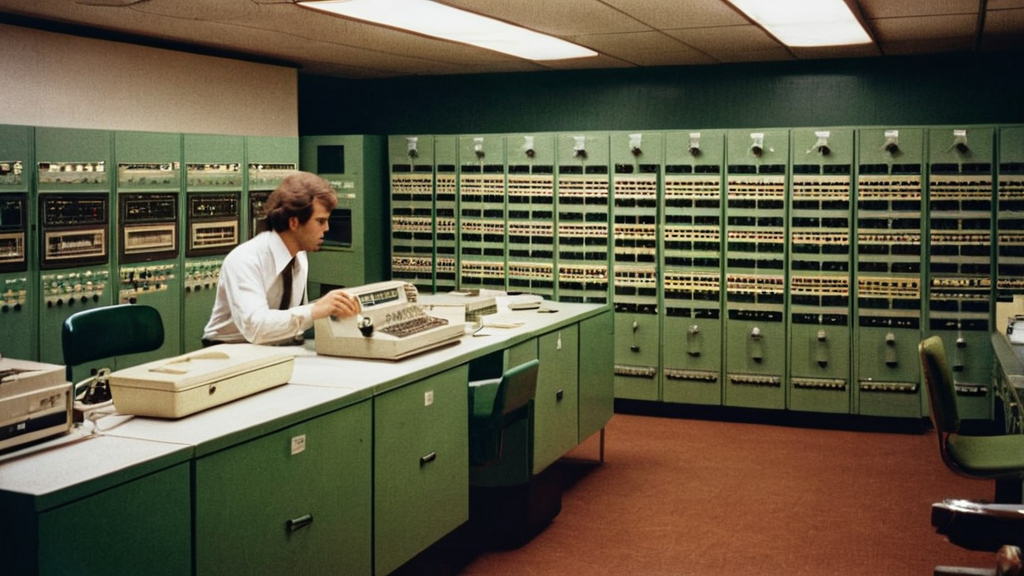
Every era before this one, I asked the master to show me his spell. This is the era when the spells stopped needing masters — when a rule could be written so exactly that a humming metal box would cast it all weekend without ever once having a feeling about it. The strangest workshop on the journey has no roar at all. It has a hum.
The step through
Every market I have visited announced itself. The olive presses creaked. The tulip tavern shouted. The rice bridge rang with fists on rails, and even the dancer's era chattered at me through a glass-domed ticker.
This time the door opens on quiet.
An office, 1960. Fluorescent light with a faint hum in it, the smell of paper and pencil shavings, and a man at a tidy desk who is not watching a market at all. He is measuring one. Charts of wheat and copper and soybeans lie squared before him, and he works along them with a straightedge the way a carpenter works along a plank — no tips in this room, no whisper-men, no feelings. A ruler.
I have arrived in the era when magic became measurement. It will take me twenty years and four masters to cross it, and the door, as it did on the dance tour, will keep moving. Follow the hum.
The market of that age
Understand what America's markets are in these decades. New York still keeps its stock temple, and you have already seen its boardrooms — the ribbon of prices read like entrails, the noise arriving at the speed of electricity. But the masters of this era mostly work another room: the commodity markets, wheat and sugar and copper and bellies of pork — the price of the nation's breakfast, negotiated at full volume — traded by shouting men in Chicago and New York much as rice was traded on the Dōjima bridge.
What is new is not the market. What is new is standing quietly beside it: the machine. Rooms of metal cabinets that do arithmetic without opinion, built to keep a brokerage's books, idle on weekends. Nobody built them for magic. And yet this is the era's whole discovery, the one every visit before it was secretly preparing: a machine can cast any spell you can write down exactly — and only those.
Hold that sentence. It is about to become the most honest examiner the craft has ever had.
The chartist's ruler
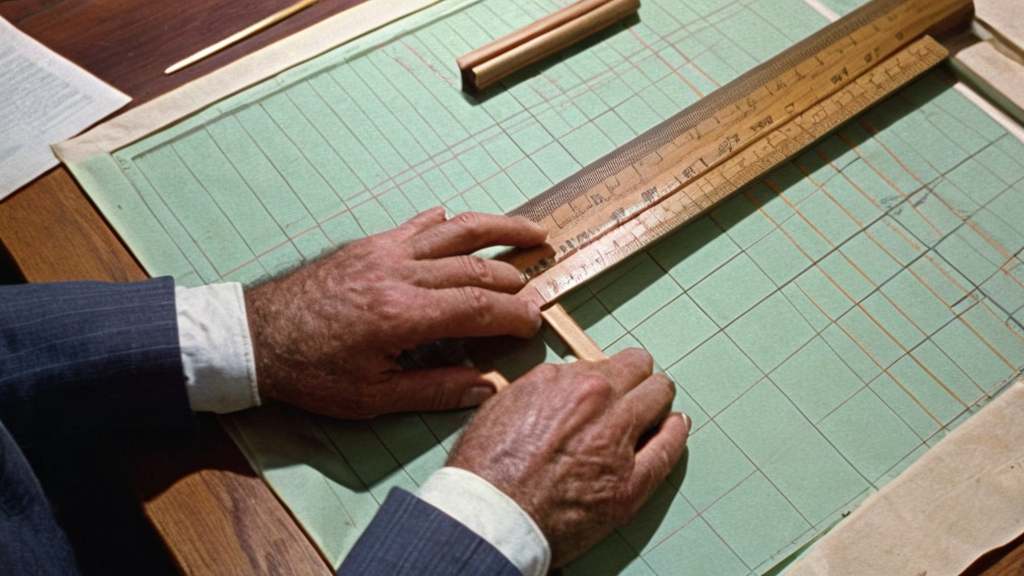
The man with the straightedge is Richard Donchian, and the rule he is drawing is so simple you will think I am leaving something out. I am not. That is the point of him.
Look back over the recent stretch of any chart — say the last few weeks of days. Find the highest high in all of it. Draw a line there: a ceiling. Find the lowest low; draw the floor. Price lives between them like a tide between two marks — until the day it doesn't. When price climbs above the highest high of the last N bars, buy. When it breaks the floor, you are out. That is the whole spell. A channel, drawn from nothing but price's own record, and an order standing at the roof of it.
You have seen this shape before. Two visits back, a dancer in a hotel lobby was stacking boxes — ceilings price failed to break, floors it refused to fall through, a purchase only on the climb through the roof. Darvas built his boxes by eye, one stock at a time, from a week-old newspaper. Donchian takes the same shape and does the thing no master before this era thought to do with a spell.
He removes himself from it.
No judgment about which ceiling matters. No sense of the stock's story. No eye at all — just a count: the highest high of the last N bars. Any clerk could follow it. Any child. And notice — this is the hinge of the whole era — anything a clerk can follow without asking questions, a machine can follow too.
Here is the book's first lesson, standing in an office in 1960 wearing a tie. A spell, we said on the very first page, is exact language: speak it precisely and it changes the world, mumble it and nothing happens. A trading rule is the same creature. "Buy strength" is a mumble. "Buy the close above the highest high of the last twenty bars" is an incantation — every word load-bearing, nothing left for the mood of the caster to decide. Donchian's gift to the craft is not the channel. It is the demonstration that a rule could be written that exactly — because only rules written that exactly can be handed to what is coming next.
Before we follow the door: put your own hands on it tonight. Open any chart. Count back twenty candles. Lay your finger on the highest high among them and trace the ceiling forward. You have just drawn Donchian's channel with the original instrument — a finger is only a slower ruler. You are under the same vow as every visit: trace it, watch it, trade nothing. Watch what price does when it finally climbs through that roof.
This little rule is the grandfather of the book's whole school of fire — the pursuit spells, the ones that chase a move already running. Keep your eye on it. In a later visit it will be handed, almost unchanged, to a room full of beginners in Chicago, and the wager riding on that handoff will be one of the finest stories the craft owns.
The weekend of punch cards
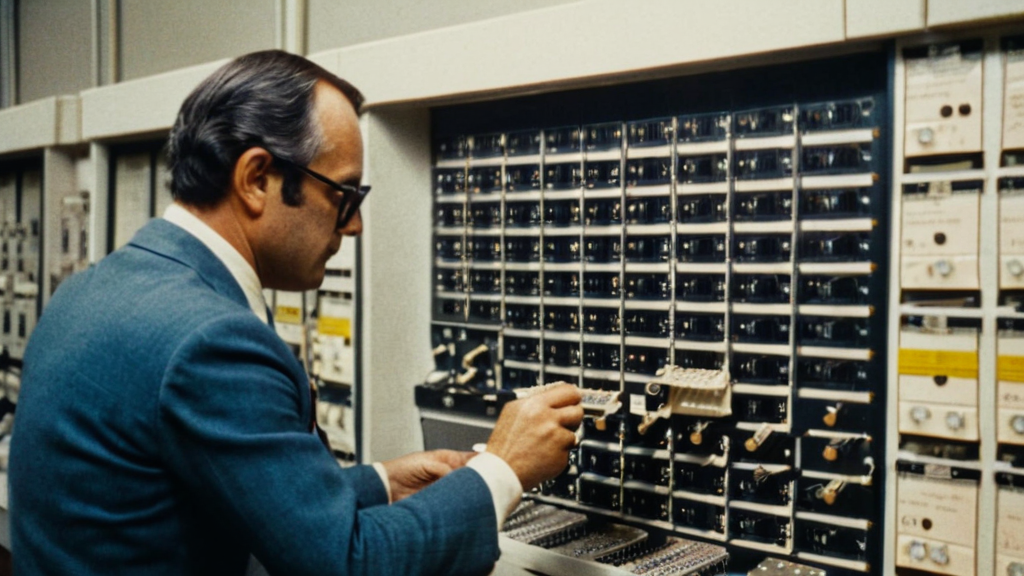
The door moves. Ten years forward, and the quiet deepens: a brokerage house on a Saturday, empty as a church on Monday, every desk abandoned — except that somewhere below, something is humming louder than the lights.
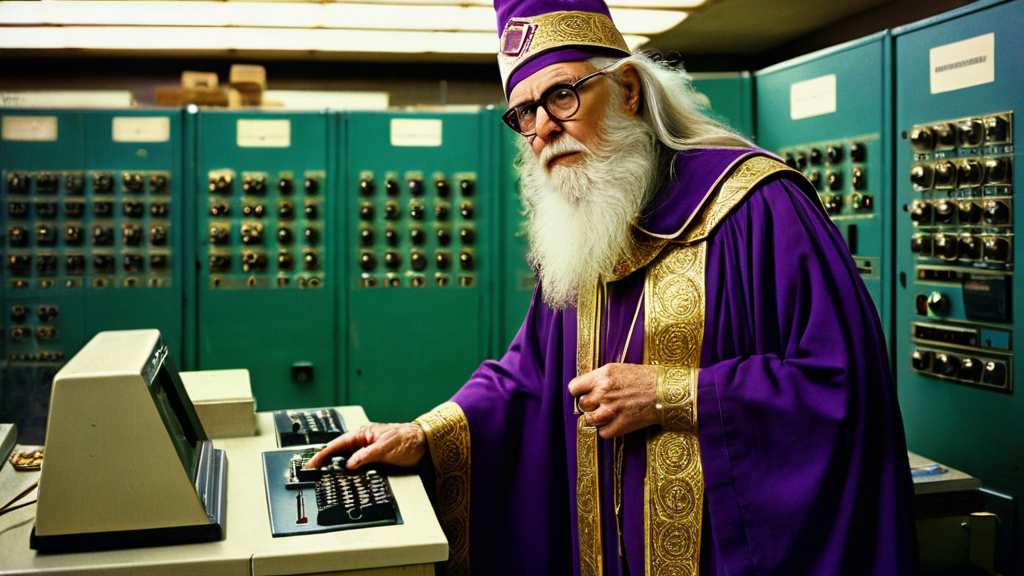
In the machine room, a young man is feeding rectangles of stiff paper into a metal cabinet the size of a wardrobe. Each card carries one day of one market, holes punched where numbers ought to be. He has spent his evenings punching them by hand from the newspaper's price tables. The firm's great accounting machine — an IBM 360, rented to balance books, idle on weekends — is reading them faster than he ever could.
Ed Seykota, and what he is doing has, so far as I can tell after twenty-six centuries of visits, almost never been done before: he has read a master's spell, and instead of believing it or doubting it, he is checking it.
The spell he is checking is Donchian's work — the exact-rule school you just met. And because the rules are exact, the machine can cast them backwards across history: ten years of prices, eight different markets, four families of spell, and for each family some fifty different settings of its dials. By his own account it took him half a year of weekends. Half a year of weekends to do what my scrying pool now does before lunch — and I crossed twenty-six centuries believing the pool had shown me something new.
Because listen to what the punch cards told him, in 1970:
First: many settings worked. Not one magic pair of numbers, but a broad ridge of them. The power was never in the precise figures — it was in the shape of the rule. A spell that only works at one exact setting of its dials is not a spell; it is a coincidence wearing robes. The craft would need decades to name this — robustness beats tuning — and my own silver box confirmed it half a century later, having no idea it was confirming anything.
Second: the quick versions died. Every cast pays a small toll — the broker's fee, the sliver lost between asking and getting. On the slow, patient versions of the spells the toll was a rounding error. On the rapid, short-term versions it was the whole harvest. The faster the magic, the more of it the toll ate, until nothing was left for the caster. He measured the trap on punch cards in 1970. My pool refound it, toll for toll, on fifteen-minute candles half a century later. Some laws do not care what century you test them in.
Out of those weekends came what is generally credited as the first computerized spellbook ever to trade real clients' money in the futures markets. And now the era's funniest scene, which I must label honestly: it comes from Seykota's own telling, retold for decades, audited by no one. The machine's counsel, followed faithfully, would have won handsomely that first year. His managers could not resist improving on it — a veto here, a feeling there — and the improved accounts showed a small loss. Then, having overruled a winning machine into a losing one, management made its request: could he please retune the thing to cast more often? More casts meant more tolls, and the tolls were paid to the house. He had built a truth machine, and been ordered to detune it into a fee machine. He left, and ran his own book, alone, by his own rules, for decades — famously without so much as a live price screen, his whole market day the few minutes it took to run the spells and write out the next day's orders.
The legend that grew around that quiet book carries a number, and I hand it to you the way this book hands you every legend: a client account, the story says, grew by hundreds of thousands of percent across sixteen years. That figure is REPORTED — one interviewer's book, never audited, retold ever since. And here is what makes Seykota worth a visit rather than a footnote: he would be the first to tell you to check. He is the man who heard a great master's spell and bought machine time to test it. Extend him exactly the courtesy he extended Donchian. Believe the method; audit the miracle.
One more scene, out of order and irresistible, and this one is verified: the most private great trader of his era, unseen for decades, finally made his first public appearance — on the young internet, cheerfully singing his own trading rules to a banjo. The rules in the song are his whole published method, and they will sound like an old friend from a fogbound visit long ago: ride your winners. Cut your losses. Manage your risk. Use stops. Keep casting through the storm. And file the hot news where it belongs — in the file, not the order book. Ricardo's commandment from 1815, set to bluegrass. The craft's deepest laws, it turns out, survive any instrument.
The calipers
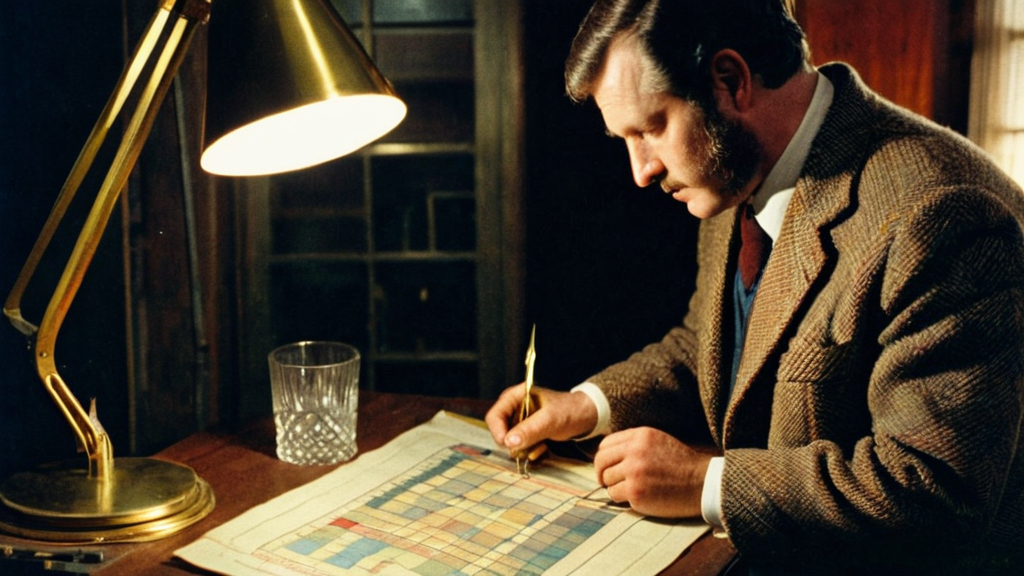
The door moves again. 1978 now, and the room is an office thick with graph paper and worked-out arithmetic, somewhere in the American South. The man here is not casting spells at all. He is building instruments.
J. Welles Wilder is the era's toolsmith, and his trade is the humblest and most necessary one in this whole book: before a machine can obey a rule, someone must write down what the rule's words mean. Every trader alive says things like "it's stretched too far" or "give it room to breathe." A machine cannot hold too far or room in its metal hands. Somebody has to turn those feelings into measurements — to forge the calipers.
Wilder forged two the craft still carries everywhere.
The first gauges how far stretched a market is. It weighs the recent climbing days against the recent falling days and speaks a single figure between zero and one hundred: near the top, the move has been almost all climb, a bow drawn nearly to its limit; near the bottom, almost all fall. He called it the Relative Strength Index — RSI — and you have likely seen it under a chart without knowing it was ever new. It is the instrument behind this book's school of water: the snap-back spells, cast when something is bent so far that letting go is the likeliest next event. In my own lab that family proved rare and strong — few casts, fair weather chop — but that ledger is for a later chapter.
The second gauge answers a question you will not realize is profound until you try to write a rule without it: how far does this market normally reach in a bar? Take each bar's true span — including any overnight leap — and average it. He called it the Average True Range, ATR: the market's normal stride. And here is why it matters more than it looks. "Set your stop a little below" is a mumble. "Set your ward two normal strides below" is an incantation — because normal stride is now a number the machine can look up. Wilder's tape measure is what let wards and sizes scale themselves to each market's own gait, calm or wild, copper or wheat, without a human guessing. Half the exact spells cast in the world today, whatever school they belong to, quietly carry his calipers in their pockets.
He wrote the instruments down in 1978, plainly, formulas and all, for anyone to use. No secrets, no sealed methods. (In an era when lesser men sold secret systems in sealed envelopes, this counted as eccentric behavior.) The Machine Age's toolsmith published his tools — which is, when you think about it, the only behavior that makes sense in an era whose whole discovery is that exactness, not secrecy, is where the power lives.
The storm gauge
One more door, and the era's quietest master. 1980, and this room is not even near a market: a scholar's room, all journals and derivations. Michael Parkinson is not a trader. He is a measurer of storms.
His insight fits in a sentence: if you want to know how rough the sea ran today, do not ask only where the ship ended up — ask how high and how low it pitched along the way. Any green-faced passenger could have told the captain as much; Parkinson's contribution was proving it with arithmetic. The whole span of the day, top to bottom, carries more news about the storminess of a market than the closing bell alone. Out of that he built a better storm gauge: a way to read, from the day's range, how violent the weather has been.
And now, for once on this journey, the teaching runs the other way — because what the storm gauge can and cannot do is a law my own lab measured, and I can teach it to you here, in his room, where it belongs.
Back home, I put Parkinson's gauge in front of every tool in my pack — thirteen spells from all the schools, fire and water and the rest — and asked each one: do you cast better when the gauge reads calm, or when it reads storm? Thirteen tools. Thirteen identical answers. Not one spell broke ranks. The split was thirteen to nothing.
13–0the storm gauge
?the router
A measure that splits the schools into camps — and so can choose which spell. It waits fifteen years up the road, with the last master of the journey.
At first that sounds like triumph. It is actually a boundary, and learning to see it is a full degree of illumination. A gauge that moves every spell the same way cannot help you choose between spells — on the one question where the schools disagree, it has no opinion. What it can do, it does perfectly: it tells you about the field itself, the one every school stands on. So the storm gauge is a gate — it may tell you whether this is weather for casting at all. It can never be a router — it cannot tell you which spell the hour calls for. Whether, never which. Carve that over the door of this room.
Is there a measure that does split the schools — that reads the weather one family loves and another hates, and so can actually choose? There is. It waits fifteen years up the road with the last master of the journey, and it is the reason this book exists. The storm gauge's honest failure is what taught me to recognize the router when I finally met it: not every measurement that glows is a compass. Some are lanterns. You need both, and you must never mix them up — a lantern held up as a compass will walk you in circles, brightly.
The lesson taken
Now the ledger, and this era lays four gifts on the table at once.
From Donchian: the channel — a ceiling and floor drawn from price's own record, and the proof that a real spell can be written with no caster inside it. From Seykota: the checking — and the two laws the punch cards taught, that a true spell works across a broad ridge of settings, and that the toll eats quick magic first. From Wilder: the calipers — stretched and stride turned from feelings into figures, so wards and sizes could finally be exact. From Parkinson: the storm gauge, and its boundary — whether, never which.
But the deep gift of the Machine Age is the one all four were holding without saying, and it closes a circle this book opened on its first page.
We began with the claim that a spell is exact language — that a strategy speaks precisely or it does not work at all. In every era before this one, you had to take that on faith, because the only casters were human, and humans mumble. A trader with a vague rule and a good year cannot tell you which of the two did the work. Then this era built a caster that cannot mumble. A machine casts exactly what is written — no mood, no mercy, no Friday-afternoon improvisation — and so, for the first time in the history of the craft, a rule could be separated from the hand that held it and asked, alone, under oath: are you real?
That is why writing a rule exactly enough for a machine and writing a spell exactly enough to work are not similar acts. They are the same act. The Machine Age did not add magic to the craft. It added honesty — an examiner that flatters no one, which is precisely what Seykota's managers could not bear, and precisely what a serious wizard cannot live without.
And the machine's verdict on the era's own grandfather spell? Back home I ran the channel's direct descendant through years of replayed weather, every cast paying its honest toll, and here is this visit's number, arriving last and alone as always.
40.1%wins in clean wind
The channel's child, cast in trending weather — and a pursuit spell's few wins are long, which is where its living comes from.
15.0%wins in chop
The same rule. The same words. The same tireless machine. Only the weather changed.
Sit with the pair a moment. The machine did not make the spell good, and the machine did not make it bad. The machine revealed that the weather decides — that the rule was never the problem and never the whole answer. Magic is neither light nor dark; the wielding decides, and the first act of wielding is choosing the weather you cast in. Every humming cabinet in this era is pointing, without knowing it, at the one spell none of these masters forged: the choosing itself.
The step back
The machine room hums on behind me — cards riffling, a spellbook being examined at a thousand days a minute, telling somebody the truth whether they like it or not.
The door ahead has found its noise again. Through it I can already hear something Amsterdam would recognize and the quiet men of this era would not: a roar. Hundreds of voices shouting prices, hand-signs flashing over a sunken floor, jackets the colors of playing cards. Chicago. The pits, in their loudest decade.
And in the middle of that roar, a trader is preparing the strangest wager of the century — not on wheat, not on bonds, but on people. He has taken the exact-rule school this whole era just built, Donchian's channel among its bones, and he is about to bet a rival that he can teach it to anyone: a handful of beginners pulled from ordinary lives, handed the rules, and set loose with real money. If the Machine Age proved a spell can work without a master inside it, he means to prove something stranger — that the master was never the ingredient at all.
They will call his students the turtles. I have been calling their spell family that this whole book, and now you know why the name was waiting.
Step through with me. It is 1983, and the roar is deafening.