The trick-edge: it lived in a seat, and the seat was lost.
☶
Magic in the Markets
Adventure · Visit IX · New York, 1869
The Gold Room
I buy when things are low and nobody wants them.
♪ Velvet Cards · the music of New York, 1869 · MoneyWizard
The strangest weather on the whole journey: a storm built by men, on purpose, for money. Two rogues to recognize and never to admire — and, an ocean away, a woman in plain black who carries the counterspell: cash, kept ready, cast before the sky breaks.
The step through
Every other door opened onto weather that belonged to nobody. The monsoon over the rice bridge, the fog in Capel Court, the sea wind over the olive groves — storms and calms without owners, which is why the masters could learn to read them: the sky does not cheat.
This door opens onto a roar with a ceiling.
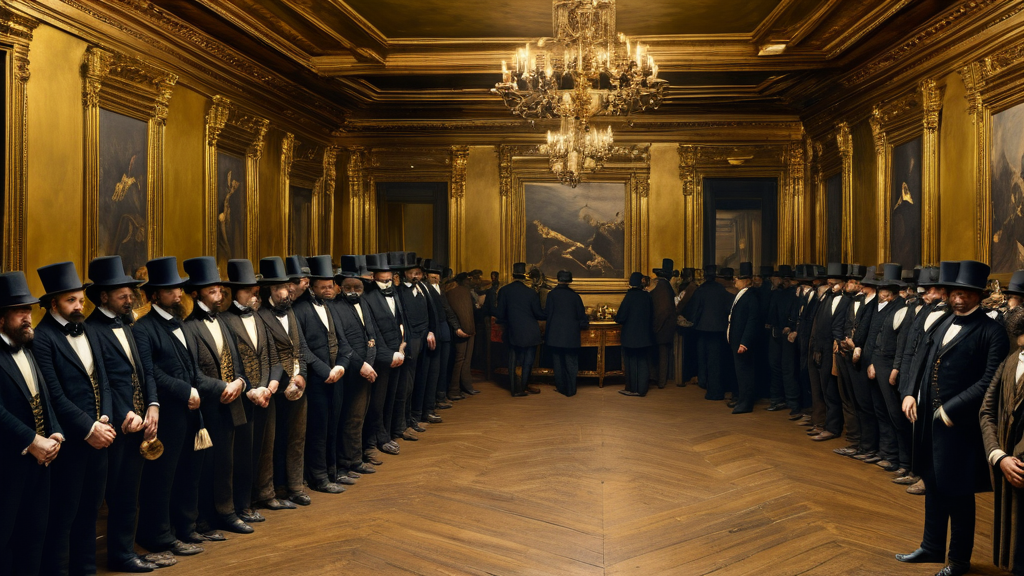
New York, the morning of Friday, September 24, 1869. A hall off Broad Street, packed so tight the black coats have stopped being separate coats, and every man in it is screaming the same number at every other man — bidding it, cursing it, begging it. Paper slips fly like startled birds. The number is the price of gold. And it is climbing the way nothing natural climbs — vertically, joylessly, like something being hauled up a wall on a rope.
They call this hall the Gold Room, and to understand why such a room exists you need one minute of history, so take my sleeve. The war that just ended was paid for with printed promises — paper money the country calls greenbacks. Gold stayed what it had always been: the money of the wider world, the coin a merchant across the ocean will actually accept. So in America, for a few strange years, gold itself has a price — so many paper dollars for so much gold — and that price wobbles daily with the country's fortunes. This room is where the price is found.
Or where it is supposed to be found. I have read weather for a great many centuries, and it takes me less than a minute in that hall to feel what is wrong with this storm. A real storm gathers. This one is being hauled. Somewhere above the shouting, a hand is on a rope.
Every other visit, I stepped through to find a master. This time the door has brought me to watch a crime.
The market of that age
Understand the country this room sits in, because it explains everything you are about to see.
America after its war is growing faster than its rules. Railroads are the marvel and the fortune of the age, and around them has gathered a species of money-man the old eras never quite produced — because the old eras never offered him this much unguarded machinery. In this New York a judge can be bought like a winter coat. A legislature can be rented by the session. And the treasurer of a great railroad can create fresh shares of it the way a baker makes rolls. When a trader of your century mutters that the whole thing is rigged, they are remembering this place without knowing it. Here the sentence was not bitterness. It was reporting.
So this visit breaks my habit, in two ways. In every other era I found a master and begged a treasure. Here I will show you two men whose treasure I refuse to carry — because their magic only works if you own the henhouse, and because you will meet its descendants in your own era, wearing modern clothes, and I want you able to name them on sight. That is old magic, the oldest there is: a thing you can name loses half its power over you.
And then, because I will not leave you standing in a burning room, the door will open once more — same year, other side of an ocean — on the one person in this whole gilded era whose spell went straight into my pack. Remember, while the rogues are on stage, that she is out there: calm as a lighthouse, already holding what everyone in this hall will be begging for by nightfall.
Uncle Daniel, who salted the cattle
Start with the older of the two, because the whole era is his fault, more or less.
Daniel Drew, born 1797 in the farm country upstate, began as a cattle drover — walking herds down to Manhattan and selling them by the pound. And here arrives the founding legend of an entire category of mischief, so let me hand it to you with its label showing. The story says that on the last night of the drive, Drew fed his steers salt. By morning every animal was mad with thirst, drank itself swollen at the trough, and stepped onto the scale carrying fifty pounds of water that Drew sold as beef. When he later moved to Wall Street and sold paper that weighed more than the company underneath it, the Street reached for the old drover story and called the trick watered stock — a phrase still sitting in your dictionaries.
Now the honesty, because this book buys no swollen cattle: that salt-and-trough scene comes mainly from a book published thirty years after Drew died, written in his voice by another man's hand, and historians pick it up with tongs. The legend says salt. The ledgers — which are real — say dilution, again and again, in companies he ran. Legend and ledger disagree about the cattle and agree completely about the man.
By the 1850s the drover had become a financier, had beaten the richest shipping man in America in a steamboat fare war, and in 1857 got himself made director and treasurer of the Erie Railroad. Hear that title the way the era heard it: he was treasurer of a railroad the way a fox is treasurer of a henhouse. The job gave him the keys, the books, and the seal that made new shares legal.
His favorite sport was selling what he did not own. It works like this, and in its plain form it is ordinary enough: borrow shares, sell them dear, and hope to buy them back cheaper before you must hand them back — a way of profiting from a fall. The Street hung a rhyme on him for it: he who sells what isn't his'n, must buy it back or go to prison. And here is my favorite small joke of the entire era: the rhyme itself is watered stock. The earliest anyone can find it pinned on Drew is a novel printed nineteen years after his death, and an ancestor of the verse was chalked on an English prison wall decades earlier by a boy jailed for stealing. An old rhyme with Drew's name printed into it after the fact — diluted attribution, sold as history. I keep it in the book because of the label. It is too perfect a specimen to leave out.
One more Drew classic, labeled legend and worth every ounce of its salt. Some young operators once beat him in a trade and spent days laughing about it around town. Drew appeared at their club one evening, hot and flustered, mopped his brow with a great white handkerchief — and a slip of paper fell from his pocket, unnoticed. The moment he left, they pounced on it: a juicy order in a stock called Oshkosh. They pooled their money and bought heavily the next morning — from Drew's own broker — and Oshkosh fell like a dropped anvil, day after day. The tale is polished smooth by a century of retelling and may well be invented. But it is the purest picture ever drawn of the planted tip, which is why it refuses to die. Write its rule somewhere you will see it: information that arrives flattering you as its discoverer should be priced at exactly what you paid for it.
The war of the printing press
In 1868 Drew's mischief graduated into open war, and the war introduces our second rogue.
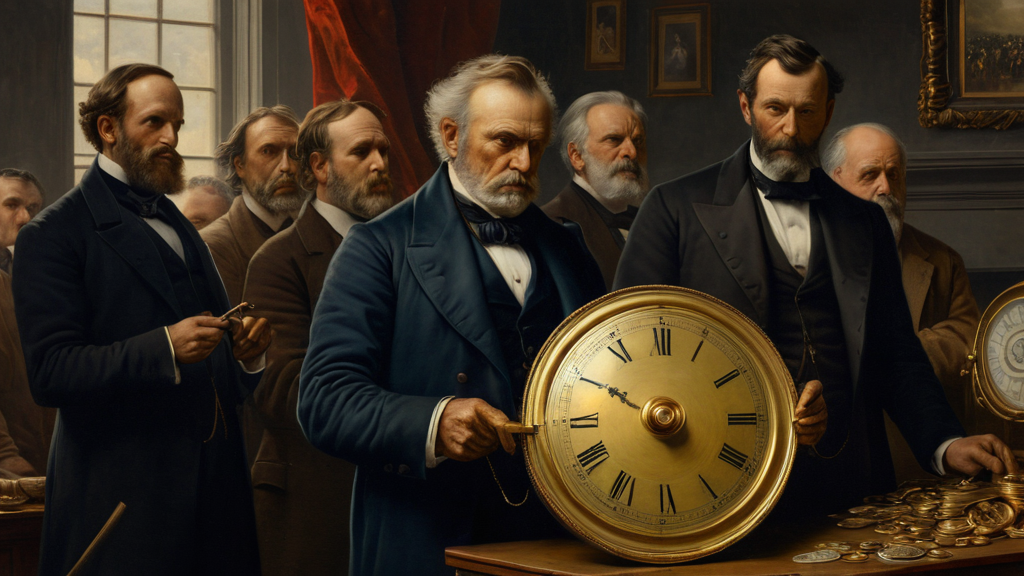
Cornelius Vanderbilt — the richest man in the country, a man who bought railroads the way you might buy bread — decided to take the Erie from Drew by the simplest arithmetic there is: buy every share that exists. Against anyone else on earth this works. There are only so many shares.
Against the fox-treasurer it had a flaw. The Erie's board had blessed a special kind of paper that could, with the treasurer's seal, hatch into brand-new shares — and Drew, allied now with two younger men, a showman named Jim Fisk and a quiet one named Jay Gould, hatched it: fifty thousand fresh shares, fed straight into Vanderbilt's buying. The Commodore was trying to drink the ocean while the treasurer stood behind him with a hose. Fisk is credited with the era's best line about it — that so long as the printing press held out, the old man could have all the Erie he wanted — though nobody wrote it down at the time, so take it as the era's joke rather than his sentence. Vanderbilt poured in an estimated seven million dollars and owned no larger a slice of the Erie at the end than at the start. That is watered stock, whole: the hose behind the buyer. Whenever you see hungry demand being quietly met with freshly manufactured supply by the very insiders selling it — new shares, new tokens, new allocations — the price is not discovering value. It is filling a hose.
Vanderbilt's answer was not the market but the referee: he bought a judge, who issued injunctions and arrest warrants. The trio bought a judge of their own, who issued the opposite. And when the warrants came anyway, the directors of one of America's great railroads stuffed bags with millions in greenbacks and securities, crossed the Hudson by ferry, and set up the railroad's government-in-exile in a Jersey City hotel — guarded by hired police, watching the ferry slips for kidnappers, while New Jersey cheerfully passed a law to shelter them. The newspapers called it Fort Taylor. The popular version has them fleeing with the printing press itself under one arm — too good to be true and, as far as the record shows, not true. The press stayed. The money ran. For weeks a major American railroad was governed from a hotel bar by fugitives, and I want you to laugh at that, because it has earned it.
The war ended where it was always going to end: Albany. Gould appeared at the state capital carrying a satchel reported at half a million dollars, and the legislature swiftly discovered the merits of his cause. The story is told — bribery keeps thin records, so it stays a story — that one state senator took a handsome sum from Vanderbilt's side, a handsomer one from Gould's, kept both, and voted with Gould. The bill legalizing the hatched shares passed. Vanderbilt settled. And then, in the quiet after the war, Gould and Fisk eased old Uncle Daniel out of his own henhouse. Hold that detail. It is the beginning of this era's one honest lesson.
The quiet one and the golden rope
Jay Gould, born 1836 upstate, came up a surveyor and a tanner: small, silent, sickly, and by the common judgment of everyone who ever faced him, the coldest intelligence on the Street. Fisk was an opera-house showman. Drew was a pious old drover who founded a seminary between raids — he was, all his life, sincerely religious, which I leave you to sit with for as long as you need. Gould was neither showman nor churchman. Gould did the arithmetic.
And in 1869, running the Erie with Fisk, the arithmetic said something enormous. The gold actually circulating on the New York market — the floating supply that changes hands in that roaring room — was small. Perhaps fifteen million dollars' worth. A determined ring could buy it all, and then buy more: promises from the sellers-of-what-isn't-their'n to deliver gold they did not hold. When delivery came due, those men could buy their gold at only one counter — yours — at your price. The scheme is called a corner, and the name is exact: you have walked the entire market into a corner, and you are the corner.
But every corner has the same mortal enemy, and Gould's had the largest one ever assembled: real supply. The United States Treasury sat on gold enough to drown any corner ever built. If Washington sold even a little, the corner dies in an afternoon. So the true work of the scheme — mark this — was never the buying. It was capturing the referee. Gould cultivated a speculator who had married the President's own sister, and through him whispered into the White House that selling gold would hurt the farmers. Through the same channel a friendly general was installed as the Treasury's man in New York — the officer who would know first if the government ever decided to sell — with a piece of the action for his trouble. Then, and only then, the ring began to buy. Mark the order of operations: the gold came last. Any fool with money can buy gold; it took Gould to go shopping for the referee first.
All September, gold climbs. That is the rope I felt on the weather the moment I stepped through the door.
The morning it broke
Stand with me in the hall now, on the morning the door chose: Friday, September 24, 1869.
Gold has spiked to 162, a number men are screaming like a fire alarm. Paper fortunes are being made by the minute; the men who sold what wasn't their'n are being roasted alive. But above the roar, the President has already moved. Grant had grown suspicious — a letter out of his own family's household tipped him that he was being used — and he has told the Treasury to break it.
Word reaches the hall: the Treasury will sell four million dollars in gold.
That is all. Four million, against a ring that fancied it owned the market. But a corner is a spell with exactly one counterspell, and this is it: real supply arrives. The price falls from 162 to the low 130s in minutes. Not hours — minutes. The roar becomes a different kind of roar. Brokerage houses die where they stand; the stock market craters alongside; and out across the country, farmers and merchants who never heard of Jay Gould — people who only needed to change money or sell a harvest abroad — are wrecked in the wash. The day enters the language as Black Friday. The original one. The one every later black day is named after.
I will not soften what came next: the storm's authors did not drown in it. Gould, by the standard accounts, had begun quietly selling before the break while the buying still roared around him — how early and how much he saved is argued to this day; that he fared far better than the public is not. Fisk's brokers simply refused to honor their promises, and purchased judges sheltered them both. A congressional investigation cleared the President; the Treasury's friendly general resigned; nobody went to prison. He who sold what wasn't his'n, it turned out, mostly retired to New Jersey.
But before you conclude that the wicked simply win, look at the wreck's exact shape, because there is a real lesson in it. The authors could raise the storm. They could not steer it. The corner still died the only way corners die. The break still came in minutes, at nobody's chosen hour, and it burned members of the ring alongside the crowd. A rigged market is not a controlled market — it is an honest storm with extra arsonists. Which means the defenses that work against weather work here too. And the greatest of those defenses is standing at a desk an ocean away, and it is finally time to meet her.
The second door
I step out of the wreckage of Black Friday, and the door does something it has never done: it opens twice in one visit. Same year. Other side of the ocean. I checked the hinges. The hinges were fine. It was the century that needed two tries.
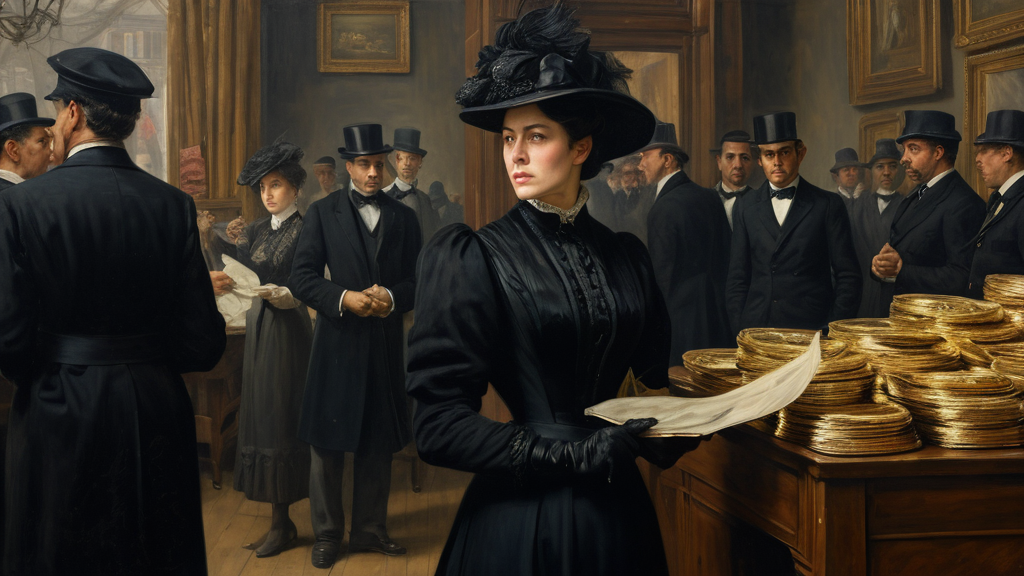
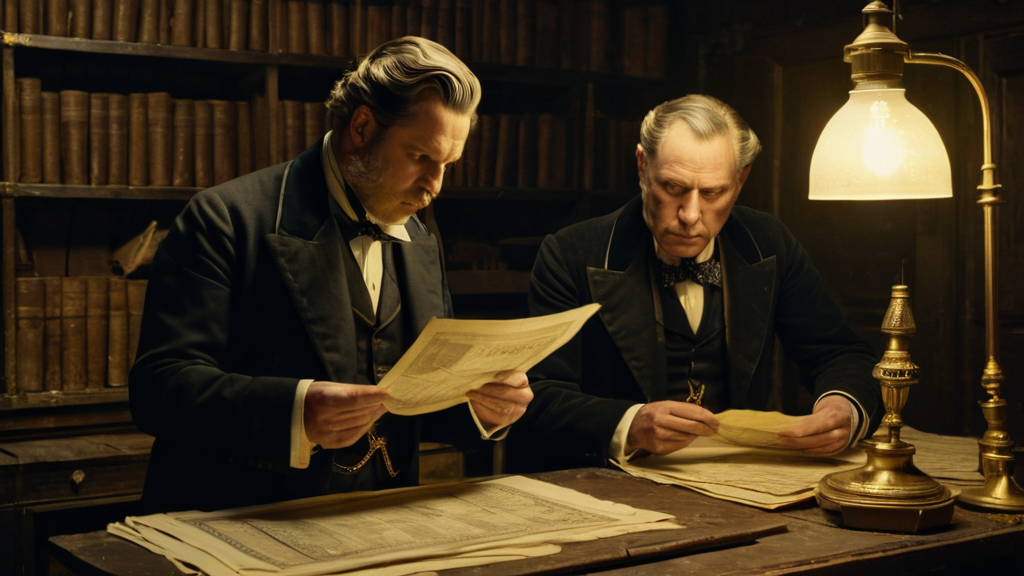
London. A quiet room, a desk, ledgers in a neat hand. A woman of thirty-four in plain Quaker black is doing the era's least fashionable thing with money: buying the promises of the United States — the greenbacks and the government's gold-backed bonds — at the beaten-down prices of a country half the world still doubts. Buying what nobody wants, in quantity, calmly, and tucking it away.
Henrietta Howland Green. Hetty, to a century that never once got her right.
Her beginning is verified, and it is better than fiction. New Bedford, Massachusetts — the whaling capital of the world — born 1834 into a Quaker family of ships and ledgers. Her grandfather's eyes were failing, so from the age of six the small girl read him the financial pages aloud, every day: stock quotations, commodity prices, shipping news, performed at the fireside the way other children performed fairy tales. She opened her first bank account at eight. By thirteen she was the family firm's bookkeeper — one careful source says fifteen, and I confess I love that the record of the century's greatest bookkeeper contains a bookkeeping dispute. Other girls of her class were taught needlework. She was taught the ledger, and the ledger, unlike the era, never lied to her.
In 1865 her father and her aunt died within months of each other, and roughly six million dollars landed on her at thirty-one — much of it locked away in trusts she resented to her last day. And then, because even the greats pay a door-fee of at least one public comedy, she contested her aunt's will, producing an earlier will plus a page that purported to cancel all later ones. The other side cried forgery and put a Harvard mathematician on the stand, who counted the thirty little downstrokes in her aunt's disputed signature, matched them stroke for stroke against a genuine one, and testified that two signatures agreeing so perfectly by honest chance was a one-in-2,666,000,000,000,000,000,000 affair — possibly the first time probability arithmetic ever took the witness stand in America. She lost. The future richest woman in America enters financial history as the losing party in the founding case of forensic counting. I keep a scrying pool that runs on exactly this kind of improbability arithmetic, so I am professionally obliged to find that funny — and I do, and I suspect her bookkeeping soul eventually did too.
But watch what she does after losing, because this is the whole woman. She takes her settlement, marries on her own terms — her fortune fenced off from her husband by written agreement before the wedding, her design and her father's — moves to London, and goes shopping in the wreckage of her own country's credit. Everything unwanted, bought cheap, held until wanted. The entire career in miniature, at thirty-four, while the Gold Room across the water is burning down.
I claim my one question, as I always do. The men of your era build corners and print shares and buy judges. You buy things and wait. What is the secret?
She gives me the answer she gave a reporter of her own century, word for word, because it is verified and needs no dressing up:
"I buy when things are low and nobody wants them. I keep them until they go up and people are crazy to get them. That is, I believe, the secret of all successful business."
The counterspell
Now let me unfold that sentence for you, because it is a spell of four parts, and the first part is invisible.
Cash first. To buy when nobody wants things, you must be holding money at the exact moment nobody else is. That sounds obvious, and it is in fact the rarest discipline in this entire book. At the very first stop of this journey, a philosopher in an olive grove taught me the first option: paying a little, in advance, for the right — never the obligation — to act later if the season came good. Thales bought his option once, cheap, ahead of one harvest. Hetty carried hers permanently. A great standing reserve of ready money is exactly that: an option on every future panic, renewed every morning. (The premium was boredom, paid daily. She could afford it; boredom was the one luxury she permitted herself.) And — her refinement, the part I underline in gold — her reserve earned while it waited: lent out steadily against solid property she had inspected with her own eyes, callable home when the sky darkened. On every sunny day, holding cash while other people's paper fortunes swelled cost her a pang and nothing more — declining to act is the one move in markets that is always free. Then, one day in a decade, the whole street needed money at once, and the only person who had any was the lady in black.
Only in the storm, and only quality. She did not buy everything cheap. She bought good things cheap — railroads with real traffic on them, land, government paper, loans secured by property she had personally gone and looked at. Quality, in her practice, has an exact meaning you can carry home: an asset that will survive the very panic that made it cheap. The panic is the sale. It is not the merchandise.
Sell to the crazy; be wary of the giddy. Read her sentence again: she keeps things until people are crazy to get them. The euphoria is the exit. And she trusted that signal in the other direction too. In the years before the great panic of 1907, watching her gilded world borrow itself silly, she said — by her own account — that the rich around her were over-borrowed and a panic was inevitable, and she spent the giddy run-up quietly turning holdings into cash. When the storm duly arrived, the city of New York itself came to her desk, as it had come before, and she wrote the city a check and took its short-term bonds in payment. Her price, by her own account: those to whom she lent got the money at six percent, when she might just as easily have secured forty. Partly conscience — and partly, I suspect, craft: fair terms in a panic keep the borrower alive to repay you, and keep the city coming back next storm. When the money power of America gathered in a great library that autumn to stop the bleeding, the accounts put her in the room — commonly as the only woman in it. The attendance records are thin, so I will not paint you that room. But mark that when the tellers of the tale reached for names that made the story sound solvent, hers was one of them.
And no borrowed money. Ever. This is the deep floor of the whole method. She could never be forced to sell, because she never owed anyone the power to force her. In every crash of her long life — 1873, 1893, 1907 — the drowned were, almost to a name, people who owed: the price fell, the lenders called, and their holdings were taken from them at the bottom regardless of what they believed. Nothing could be taken from Hetty at the bottom. Her survival was not courage in the moment. It was arranged in advance. Which is this whole book's oldest law wearing a black dress: the storm decides nothing about you that you have not already decided in the calm.
There is the tension of this whole visit, so stand where you can see both sides at once. Gould's magic needed a captured referee, a henhouse seat, a rope on the weather — an edge made of position, and positions are lost. Hetty's magic needed nothing but patience, solvency, and the nerve to be the only bidder in a burning room — an edge made of preparation, and preparation cannot be confiscated. The rogues made a storm and could not steer it. She never made a single storm in her life. She simply owned the umbrella concession for half a century.
The slander audit
Now I must perform this era's strangest chore: defending my master from her own biography.
History's name for her is the Witch of Wall Street, hung on her plain black Quaker dress and hardened after she took to mourning. And around the name has grown a mountain of miser stories, which I have sorted into three piles — because sorting stories into piles is half of everything this book does.
Pile one: verified, and genuinely funny. She had a Skye terrier named Dewey whom she loved beyond reason. The city of Hoboken demanded a two-dollar dog license, and the richest woman in America, on principle, left the state of New Jersey over it — until her grown daughter quietly paid the two dollars and Hetty moved back. Her apartment doorbell was labeled "C. Dewey": the wealthiest person on the continent, hiding behind her dog's name. And when an acquaintance asked why she so adored the animal, her answer survives firsthand: "He doesn't know how rich I am." Laugh — she meant you to. Then notice it is also the loneliest true sentence of the Gilded Age, and that she said it as a joke, which is the bravest way such a thing can be said.
Pile two: legend — told everywhere, verifiable nowhere. The cold oatmeal heated on the bank's radiator. Washing only the hem of the black dress. The hours spent hunting a lost two-cent stamp. Her own biographers throw up their hands and say fact and fantasy can no longer be separated in this pile, and a famous book of world records fossilized the whole heap by crowning her the greatest miser who ever lived. Label the pile, and step over it.
Pile three: false, or torn from context — the smear proper. The tale that she died of apoplexy in a quarrel over skimmed milk: refuted — the record shows a series of strokes over months. And the cruelest one, that her stinginess cost her son his leg — this one I sorted with both hands, slowly. A true, unflattering core exists: when the boy first hurt his leg, she did once bring him to a free clinic in shabby clothes, and left when she was recognized. But the fuller record shows years of paid physicians, every remedy tried, cities moved to be near him, the boy carried in her arms in the street when he could not walk — and the family itself called the popular version simply wrong. The leg was lost to gangrene years later. The incident is real. The indictment is not proven. That distinction is the entire discipline of this book, applied for once to a human being.
And now the frame itself, plainly, with the lantern up. A man who holds ready cash and lends at six percent into a panic is called a pillar of finance, a rock, a statesman of capital. A woman who did it — better, longer, and without ever printing a share or buying a judge — was called a witch and remembered for oatmeal. Some of the men she out-lent and outlasted got statues. She got an entry under "miser." I have kept ledgers across many centuries, and I know a cooked one when I read it. Consider this page the correction, entered with a wink she would have pretended not to enjoy.
The lesson taken
Now the ledger — mine, the honest kind — and this era gets the strangest entry so far: two lessons that only make sense held together.
From the rogues, take recognition, never technique. You have now seen the machines from the victim's side, which is the only side you will ever meet them from: the hose behind the buyer, meeting your demand with freshly printed supply; the corner, owning more than exists and dying the moment real supply walks in; the raid, where a fall is manufactured loudly enough to feed on its own fear; the dropped handkerchief, where the tip you were never meant to find is the one you were precisely meant to find; and the captured referee, the master machine that keeps all the others safe. None of these is a method. Every one of them required owning the henhouse. You cannot use them — and that is not a limit, it is a liberation, because it means the game you actually play is the one where preparation beats position.
And history, for once, filed the proof neatly, in the shape of three estates. Daniel Drew — whose whole edge was the seat, the seal, the inside — lost the seat to his own pupils, was caught by them selling what wasn't his'n and squeezed without mercy, was broken by the panic of 1873, and died in 1879 dependent on his son, leaving an estate of under five hundred dollars. The man credited with inventing watered stock died worth less than one well-watered steer. Gould — who after 1873 stopped playing tricks and started buying networks: a great railroad out of the wreckage, then another system, and by 1881 the very wires that carried every price quote in America — died worth roughly seventy-two million, every cent to his family, with a scathing obituary for a monument. And Hetty — who never held a seat, never printed a share, never owed a dollar — died worth an estimated hundred million: the richest woman in her country, arguably in her world.
<$500Drew's estate, 1879
~$100MHetty's estate, 1916 (estimated)
The preparation-edge: cash, quality, solvency — cast before every storm.
Read the three lines together and the era confesses everything: trick-edges decay, because tricks live in seats and seats are lost. Network-edges compound, because rails and wires collect their toll in all weathers. And patient cash outlasted them both.
One more inheritance, and this one is already yours without your knowing it. Every rule of the market you trade under — the disclosures, the registrations, the wall between an insider's knowledge and your order — is a scar, and under every scar lies one of this era's episodes. The rules exist because these men existed. So when the small voice in you asks who is selling me this, and why — do not hush it. That voice is not paranoia. It is equipment, honestly inherited, paid for the hard way by people standing in this hall long before you.
And from the lady in black, the spell that goes in my pack, stated as a rite: keep a reserve that no excitement is allowed to touch. Let it earn quietly while it waits. Decline freely — declining costs nothing, and it is the only move that never does. Buy only what would survive the storm that put it on sale. And arrange your survival in advance, on paper, in the calm — because the panic is weather: it comes on no schedule and takes no requests, and cash is a spell that only works if it was cast before the sky broke. She is the proof of the posture this whole book keeps trying to hand you: the storm is not your enemy. The storm is the sale. Your enemy is needing anything from the storm on the day it arrives.
The step back
The door is warm behind me, and this time it tugs forward — along the wires.
Because notice what Gould bought when he turned as near to honest as he ever got: the wires. By 1881 the quiet man from Black Friday owned the network that carried every price in America. And at the end of those wires, in brokers' offices from ocean to ocean, chatters a machine I have not yet properly met: a thing under a glass dome that prints the price onto an endless ribbon of paper, minutes old and worshipped like scripture. That ribbon is about to become the temple of the next age — boardrooms turning into little theatres, a whole nation learning to read the tape — and the century it feeds runs, gathering speed and borrowed money all the way, toward a single year every soul in your world can name without knowing why: 1929.
The Gold Room taught me to smell the storm with authors. The next age will teach me the other kind — the storm with a million authors, every one of them innocent, every one of them borrowing because the fellow beside him was.
Hetty would have known exactly what to do about that. She already told us. It is always the same spell, and it is always cast in the calm.
Step through with me. The ribbon is chattering, and the twentieth century is loud.