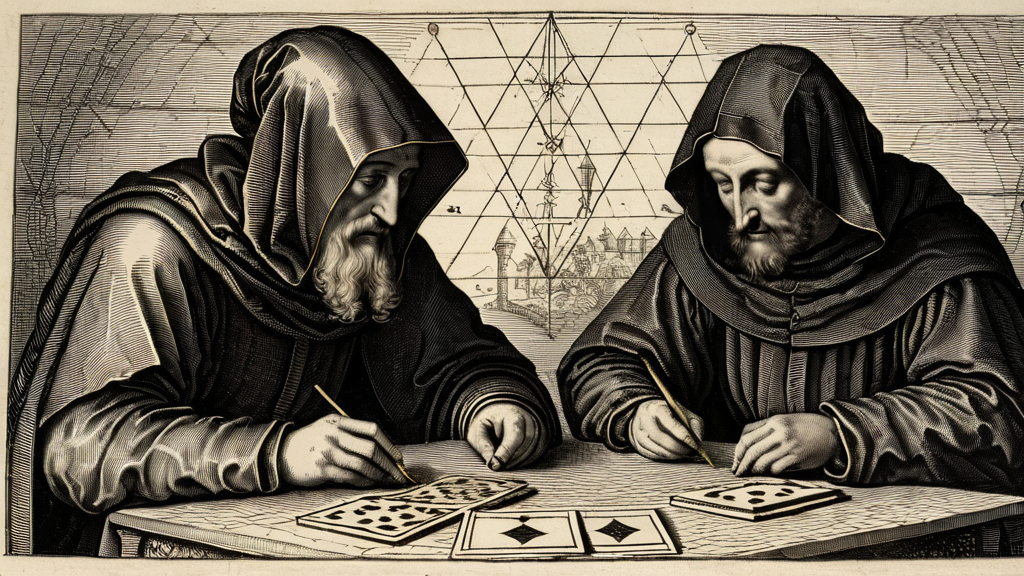
The Candlelit Quarrel
Three doors this time — a back room in Italy, a salon in Paris, a study in Basel. Behind them, the arithmetic under every bet you have ever placed is being born.
The step through
The door opens onto candlelight, and the first thing the past does is rattle dice at me.
Not Paris — not yet. The door has its own ideas tonight, and it has put me in Italy, a hundred years too early, in a low room that smells of tallow and wine and men who have been sitting too long. Because this chapter is not one man's story. It is a relay — a torch passed hand to hand across nearly two centuries, and every hand that carries it gets burned.
The first door — the man who counted the faces
At a table in the corner sits an old man with a physician's gown and a gambler's eyes, and a knife at his belt that he has used.
This is Girolamo Cardano — one of the most famous doctors in Europe, and, by his own confession, a wreck of the tables. He wrote in his autobiography that for twenty-five years he gambled not now and then but every day, and that it cost him money, time, and reputation together. He gambled away his father's small bequest. Once, in Venice, catching a man cheating him at cards, he slashed the cheat's face open and fought his way out into the street. He knows exactly what the dice have done to him.
And that is precisely why he is the first human being to count them.
Somewhere in his papers is a little book, On Games of Chance, assembled across decades of losing. In it he does something genuinely new in the history of the world: he writes down every way the throw can land — the whole circuit of cases, as he calls it — and reckons a bet's fairness as a share of that circuit. Three dice, two hundred and sixteen ways. So many favor you, so many don't. For the first time ever, luck is a fraction.
He also writes, at the end of it all, the most expensive sentence he ever earned — that the greatest advantage in gambling lies in not playing at all.
Now the part that should make you clench your fist. The book stays in his papers. It is not printed until 1663 — long after his death, and nine years after the famous letters we are about to watch. The first man to see it clearly told no one in time, and the world had to invent it all again without him. His losses bought the lesson; the drawer ate it.
The door pulls. Candles again — but finer ones.
The market of that age
Paris, 1654. Walk it with me, because this city is one enormous wager pretending to be a society.
In the salons of the great houses, gambling is practically a profession of the well-born. Dice, cards, fortunes crossing the table by candlelight while the wits trade epigrams over the players' shoulders. That is where the money of the age goes at night.
And by day? The whole kingdom is betting, in costume. The crown sells annuities — hand the treasury a lump of money now, and it pays you an income until you die. A bet on how long you'll live, made with the state across the table. In the ports, merchants buy insurance on ships and cargoes — a bet on storms. Lives are insured, lotteries fill the treasuries of kings.
Here is what should stop you cold: nobody on earth can price any of it. The annuity costs about the same whether the life being bet on is a child of ten or a man of seventy — the sellers simply don't know how to tell the difference in money. The insurance rate is custom and haggling. The salon odds are folklore. An entire civilization is up to its neck in chance, and chance has no arithmetic. Every bet in the world is being priced the way you priced your first trade: by feel, by fashion, by what the last person paid.
Into this city walks a man with a problem in his pocket.
The quarrel over the pot
His name is Antoine Gombaud, and he calls himself the Chevalier de Méré — which is worth a smile, because there is no such knighthood; it was a character in his own writings, and the name stuck. A salon wit, a gambler, and — give him his due — a man with a genuinely good eye. At the tables he has felt, through his own purse, that betting on one six in four throws of a die quietly makes money, and that betting on a double-six in twenty-four throws of two dice quietly loses it — a difference of a few bets in a hundred, caught by hand, without a single formula. You have that eye too; it's the arithmetic you were never given.
But the problem he carries into history is older and sharper. Picture the scene he had seen, and I now watch: a dice game by candlelight, stakes on the table, first man to win a set number of rounds takes the whole pot. And then — a summons, a duel, a carriage waiting — the game is interrupted, mid-stake, with one player ahead.
Who gets the pot?
The room erupts. Split it evenly? Robbery — one man was winning. Give it all to the leader? Robbery the other way — the trailing player still had real chances. Split by rounds won? A scholar named Pacioli said exactly that, back in 1494, and it's wrong too — it looks backward at the score, when the pot's fate hung on games never played. This quarrel is two centuries old when de Méré carries it to the one man in Paris who might settle it: Blaise Pascal, thirty-one, frail, one of the great minds of the age.
Pascal does something wonderful. He writes a letter.
It goes south, by post, to Toulouse — to Pierre de Fermat, a judge who does mathematics in the evenings the way other men garden, and who may be the deepest mathematician alive. Through the summer of 1654 the letters travel back and forth, weeks on the road each way, and I confess I spent this stop just following them — standing in posting-inns watching a satchel that held, though no courier knew it, the birth certificate of every market model that would ever exist. The very first letter of the exchange is lost. The hinge of the modern world, and the postman's bag ate page one.
Here is what the letters say, and it fits in a breath:
Stop looking at the past of the game. Look at its futures. List every way the interrupted game could have finished — every branch the remaining rounds could take. Count the share of those futures each player wins. Split the pot in that proportion.
In one of Pascal's worked examples: two players have staked thirty-two coins each, and the leader stands one win from taking all sixty-four. Play the possible futures out on paper and the fair split is forty-eight for him, sixteen for the other. Not because anyone feels it — because the futures, each weighed by its chance, add up to those numbers.
Weigh every future by its chance, then add them up: that is what a bet is worth. The age will come to call that weighted sum the expectation — what the pot is worth to you now, in money, before fate chooses a branch. It is the idea under every price you will ever see on a screen, and two men invented it by mail, in a few summer months, to settle a gambler's quarrel.
And then — because this era insists on its ironies — the torch nearly drops again. That same November, Pascal has a shattering religious vision in the night, writes an account of it on a scrap of paper, sews the paper into the lining of his coat, and turns his life toward God, largely leaving mathematics behind. The man who taught the world to price every future walked away from all of them; the scrap was found in his coat only after he died. The arithmetic survived because others picked it up — a young Dutchman named Huygens heard of the Paris problems, worked them out afresh, and in 1657 printed the little treatise that actually taught Europe. From there the salon arithmetic marches straight into the counting-houses: a Dutch statesman prices the state's annuities by survival chances in 1671; an astronomer named Halley builds a table of human mortality in 1693 and prices lives by age at last. Chance is becoming arithmetic — quietly, and forever.
But the relay has one leg left, and it is the one that concerns you most.
The third door — Basel, 1738
The last door opens on a study in Basel, on the Rhine — a family so crowded with mathematical genius that the Bernoullis feud with each other for lack of worthy rivals. At the desk: Daniel Bernoulli, who holds — the era winks at us — the university's chair of anatomy and botany, and who has just published the answer to a monster his own cousin Nicolas loosed on the world back in 1713.
The monster is a coin game, and I want you to feel it bite. Toss a coin until heads appears. If heads comes on the first toss, the game pays a coin. On the second, two. Third, four — the pot doubling with every toss. What should you pay to play?
Weigh every future by its chance — Pascal's own sacred rule — and the answer comes back infinite. Every future, however unlikely, adds the same slice, and the slices never end. The arithmetic of 1654 says you should hand over everything you own for one ticket.
And you wouldn't. Nobody would. Bernoulli notes, dryly, that any sensible person would happily sell this "infinite" prospect for about twenty coins. The brand-new arithmetic of chance gives an answer every child knows is madness. Something is missing from expectation itself.
Here is Bernoulli's repair, and it is the deepest thing in this chapter. A bet is not worth its pot. It is worth what the pot does to your life — and that depends on who is holding the ticket. His own example: a poor man holds a lottery ticket that pays either nothing or twenty thousand gold coins, even chances. The weighing rule says it's worth ten thousand. Is he a fool to sell it for nine? No — he is right to. And a rich man is right to buy it from him at that price. The same coin flip is worth different amounts to a beggar and a king, because a coin gained matters less the more you have, and — turn it around, this is the blade — a coin lost matters more the fewer you have.
Follow the blade one more inch, as Bernoulli does. If losses cut deeper than equal gains soothe, then betting a large share of your purse is poison even when the game favors you. Play a fair game for your whole fortune again and again, and ruin isn't a risk — it's the destination. How much of your purse rides on one throw is not a detail of the bet. It is part of the bet's worth. A good game, oversized, is a bad game.
Every word anyone will ever say to you about how much to risk descends from that page, written by a professor of botany in 1738, answering his cousin's monster.
The lesson taken
So the relay hands you two weighings, not one, and the order matters.
First, weigh every future by its chance. Not the future you want; all of them, each multiplied by its likelihood, added up in money. That is Paris — what a bet is worth.
Second, weigh your own size. The same bet is a different bet at a different fraction of your purse. That is Basel — what the bet is worth to you — and when the two weighings disagree, Basel wins, because ruin ends the game that expectation was counting on playing forever.
And now, late and alone as our custom is, the one number I brought back through the doors — because my own candlelit workshop put Bernoulli's blade to the modern test. We dealt thousands upon thousands of simulated trading lifetimes from real recorded trades of a losing book — a book of spells with no edge — hunting for the bet size small enough to be safe. There isn't one. To keep the worst lifetimes merely bruised, the risk per trade had to shrink to between five and seventy-five dollars on a fifty-thousand-dollar account — which is not trading, it is pretending, with commissions. That is Bernoulli's lesson arriving at its terminus: sizing buys time; it never buys survival. Only the edge itself buys survival. Small bets give you more throws — and more throws of a losing game reach the same cliff by a longer road. Size protects a good book. Nothing protects a bad one.
Tonight's rite costs a candle and nothing else. Take one trade you are merely considering. On paper, write its futures — what it pays if you're right, what it costs if you're wrong — and beside each, your honest guess of its chance. Multiply, add, and look at the sign. That's Paris, done with a pencil. Then ask Basel's question of the same page: if the losing future arrives, what does it do to my life — and how many times in a row could I absorb it and still be at the table? Cardano paid twenty-five years for this. You just paid a candle.
The step back
I leave Basel at dusk, along the Rhine, past windows going gold one by one — a city of candles, each one somebody's evening arithmetic.
The door swings, and history runs forward — the salons empty, the letters yellow, the coin games become the quiet machinery of every insurance office and exchange on earth. When the tide slows, I'm standing in London fog, in the spring of 1815, outside the Stock Exchange, and the whole city is waiting for news from a battlefield in Belgium.
Somewhere inside is a stockbroker's son who never read Bernoulli and doesn't need to — a man whose whole method, by his own account, is small stakes on enormous capital, taken again and again, losses cut short and profits let run. In a few weeks the most famous battle in Europe's history will settle the price of every bond in that building, and the legend of what this man did that day will outgrow his ledgers — I'll show you both, because they disagree in an instructive way. He will die the richest economist who ever lived.
Basel taught the world how not to be ruined. This man is about to show what that arithmetic looks like when a human being actually lives it.
But that's the next door.