The Dancer
Buy only when the stock climbs out through the roof of its highest box.
The strangest stop on the whole journey. A market I never manage to visit, a master I keep meeting everywhere else, and the one lesson no other century could have taught: the man who beat Wall Street did it by being as far from Wall Street as a working dancer can get.
The step through
Every other era, the door opened onto the market. The olive presses, the tulip tavern, the rice bridge, the fogbound floor in Capel Court — I stepped through and there it was, roaring.
This time I step through into heat.
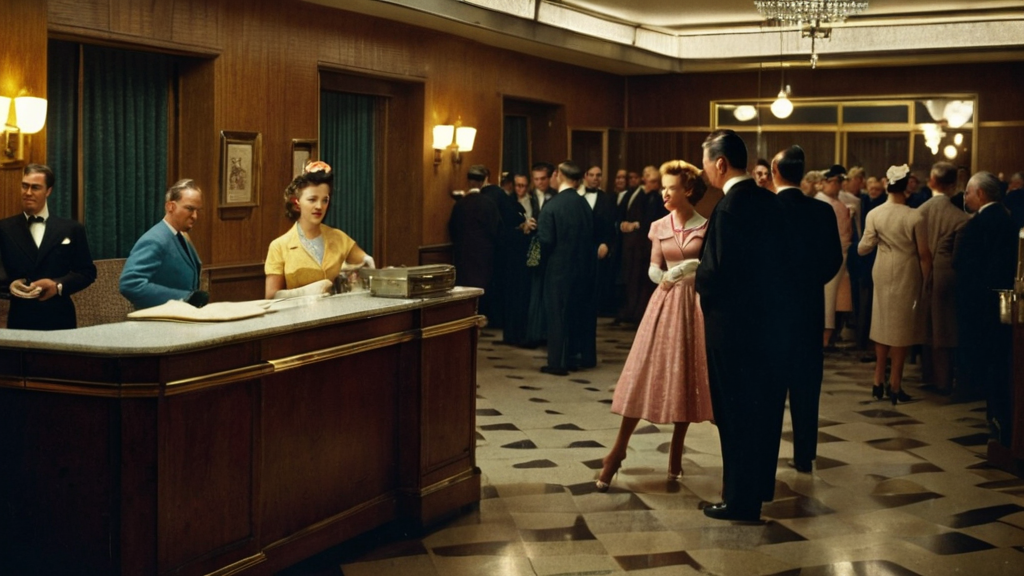
Calcutta, 1957. A stage door in an alley behind a theatre, monsoon air you could wring out like a towel, hand-painted posters going soft in the damp — a dance act, two names, European. Inside, a compact man in shirtsleeves is warming up on one leg like a stork in dress trousers. And on the chair beside him, folded with the care other men give a love letter, is a newspaper I recognize: an American financial weekly. A week old.
The door has not missed. It has taken me to the market of 1957 — I do not understand yet what that market has become. For the first time in twenty-six centuries, the market and the trader are not in the same place. To find this era's master, you do not go to the floor.
You follow the dance tour.
The market of that age
Understand first what is roaring on the far side of the planet.
New York in the late 1950s is the loudest market that has ever existed. America is flush, and the new mania has a shape nobody in Amsterdam or Osaka would recognize: rockets. The Russians have thrown a beeping silver ball over everyone's heads, and suddenly any company with electronics or rocket fuel in its story is a company the public wants — names that sound like the future, bought by people who could not tell you what the company makes.
The temple is the ticker — a glass-domed machine chattering out prices on a ribbon of paper, minutes behind the truth on a busy day and worshipped anyway. Brokers' offices keep boardrooms like little theatres where men sit all day reading the ribbon the way priests read entrails. Around the ribbon swirls everything else: tips, rumors, whisper-men, brokers with information. In London I watched news arrive at the speed of a horse; here it arrives at the speed of electricity — and notice what nobody in that boardroom has noticed. The wire did not only make the news faster.
It made the noise faster.
But the same wires do something else, something genuinely new under the sun: they stretch the market around the planet. A telegraph counter in any city on earth can carry an order to a broker in New York overnight. An American embassy in Calcutta or Saigon keeps last week's Barron's. In 1957, for the first time in history, a person can attend the world's biggest market without standing anywhere near it.
Almost nobody does this on purpose. The man I am following does it for a living — by accident.
The master
I catch up with him properly in a hotel lobby somewhere over the Pacific, in a hotel lobby with ceiling fans turning slow enough to count. At a writing desk by the cashier's cage, the stork in dress trousers is working — pencil, week-old newspaper, a stack of telegram forms.
Nicolas Darvas. Born in Hungary in 1920, trained as an economist at the University of Budapest before history made economics irrelevant. In June 1943, at twenty-three, he fled the country on a forged exit visa with fifty pounds sterling, one jump ahead of two armies, and washed up in Istanbul with nothing but his feet. The feet turned out to be the fortune: he and his half-sister Julia built one of the highest-paid ballroom acts in Europe, crossed to America in 1951, and danced their way to the top of New York's nightclubs.
His door into the market was an accident too — verified, because you would not believe it otherwise: in 1952 a Toronto nightclub could not pay him money for a booking, so it offered shares in a Canadian mining company instead. The show fell through. He kept the shares anyway — and watched a small stake multiply for no reason he could name. A nightclub too broke to pay cash handed a dancer his second career, in mining stock. That itch never left him.
He then did what you did: he lost money every conventional way first. Tips. Rumors. Brokers' information. He read some two hundred books on markets in dressing rooms between shows, burned his fingers on most of it, and what survived the burning he boiled down into a method a man can run from a hotel lobby.
Watch over his shoulder, because the whole method fits on this desk.
He is not watching prices move. He cannot — his newspaper is a week old. He is looking at where prices have stopped moving. A strong stock, he has noticed, climbs like a man on a staircase, not a man on a rope: it runs up, then rests, trading between a ceiling it keeps failing to break and a floor it keeps refusing to fall through. Price builds a box around itself. When the ceiling has gone untouched a few days running, the top of the box is set; when the floor holds the same way, the bottom is. A rising stock stacks these boxes one on top of another like crates.
His rules, in plain hands:
Not inside the box, not on a dip, not on a story — only when price does the one thing a strong stock does, which is make new ground. He wires his broker a standing order that waits above the ceiling: if it climbs through, buy me in.
The moment he is in, a second order goes under the floor: if price falls back through, the broker sells him out at once, without cabling to ask. His mistake is amputated while he is on stage in another hemisphere. Being thrown out and climbing back in later is part of the method, not a failure of it.
As each new box builds above, the escape order climbs to just under the new floor. Never down. The stock carries its own exit up behind it, floor by floor, like a rope ladder pulled up a tower.
And he never, ever sells strength on a feeling. No target, no "that's enough." Rising is the one thing he wants the stock to do; he will not punish it for doing it. The only seller in this whole method is a broken floor.
Which stocks? The ones already making new high ground, in industries whose future he actually believes in — the rocket-and-electronics names of the boom. He gave the mixture a name only an economist could love, techno-fundamentalist, which means simply: the story gets a vote on what; price gets the only vote on when.
I claim my one question while a bellboy carries his cable to the telegraph office. You could be in New York beside the ticker, first to know everything. Why trade the biggest market on earth from the far side of the planet, off a newspaper a week stale?
He laughs — he has been asked before, mostly by brokers who mean it as pity. His answer, which he would later set down in his own book: he had tried it the other way around, and being near the market had almost ruined him. Out here, the wire brings him the only thing that never lied to him. He cannot hear the crowd, so he can only see the price.
I have crossed twenty-six centuries collecting treasures from masters. This one just told me his edge is what he cannot hear.
The city where the magic died
The door keeps moving. Paris next — a cable office off the boulevards at midnight, after a show. Then a dressing room in Saigon; a lobby in Tokyo; by legend even Kathmandu — in 1958, some of the best trading on the New York market is being decided by a man in Nepal with a pencil.
All this time the run is building — the great rocket-stock rise of 1957 to 1959 — and his crates are stacking: above all a rocket-fuel maker that became the trade of his life, bought as it climbed out of a roof, floors rising behind it, never once sold on strength, and it carried the biggest part of the run.
Then comes the stretch every version of the story agrees on, though not one thing in it explodes.
He goes back to New York — and the magic dies.
By his own account, the worst trading of his life came when he was closest to the market. In New York he had everything the lobby in Manila denied him: the live ticker, the boardrooms, the whisper-men, brokers delighted to share information. And drowning in all that seeing, he began to trade like the crowd — in and out, jittery, on feelings, off tips — and the method that had run flawlessly by telegram from three oceans away fell apart in his hands at a range of one mile. The cure was as absurd as the disease: he left. He went back on the road, back to one stale newspaper and a cable line — back, in effect, to knowing less — and the results returned.
Wall Street noticed anyway. In May 1959, Time magazine gave the dancing millionaire nearly a full page in its business section, and the circus arrived: the hoofer among the bankers, out-trading the boardrooms from hotel lobbies. They printed it as a freak story. It is not. It is the cleanest experiment any master ever ran on himself: same man, same rules, same market — near the ticker he loses, far from it he wins. The only thing the distance changed was the noise.
You cannot see the weather from inside a raindrop. I built a scrying pool to climb out of mine. Darvas had no pool, so the planet did it for him: every ocean between him and the boardroom was subtraction, and the subtraction left only what was real — the price, and the boxes it built.
The lesson taken
Now the ledger. This book opens it every time, and this era's is the strangest in my pack.
He wrote his story down in 1960, and here arrives this chapter's one number, wearing a top hat on the cover of his book: How I Made $2,000,000 in the Stock Market. It sold in stacks; the title did half the work. And within months, New York's attorney general came after him and his publisher under a fresh law on investment-advice fraud, charging that the story was false — investigators, the state said, could verify only about $216,000 of profits.In January 1961 a court blocked the probe as an unwarranted invasion of the free press — and the state admitted it had never traced all his accounts, which reportedly ran through Manhattan, Panama, and Switzerland.
So the record reads: the fraud was never proven. Neither were the two million. The legend says one number, the only ledgers anyone opened say a far smaller one, and the case that might have settled it was stopped before either side could finish. I hand it to you exactly that shape — because the lesson survives either number. Two million or two hundred sixteen thousand: nobody, not even the attorney general, disputed that the method was real, written down, and mechanical enough that a man dancing in Nepal could run it by mail.
And the method is what goes in my pack. Ceilings and floors that price builds by itself. Buy only the climb out of the roof. An exit under every new floor, raised and never lowered. No selling strength on a feeling — the only seller is a broken floor. You will recognize the family: this is Ricardo's fogbound commandment — cut short your losses, let your profits run on — grown up and written exact. Darvas did not trust himself in the moment, so he built rules that never gave the moment a vote.
But the deepest thing he gave me is not the boxes. It is the distance. Every master before him worked at the heart of his market — the grove, the floor, the bridge — because there was nowhere else to stand. Darvas is the first who could stand elsewhere, and the market made him rich at a distance and picked his pocket up close. Not because the far side of the planet knew more. Because it heard less. The week-old paper was not his handicap. It was the filter, and the filter was the edge.
You cannot buy an ocean. You do not need to. His ocean was never water — it was everything the water kept out: the ribbon, the whisper-men, the minute-by-minute wiggle that begs you to have a feeling about it. Your ocean can be built at a desk, out of rules set in advance, orders that rest where you planned them, and a chart you consult like a weekly paper instead of wearing like a heartbeat. Distance is not where you are.
Distance is what you refuse to listen to.
The step back
He has a show to do. The bellboy comes back with a receipt for the cable — somewhere in New York tonight, a broker will move an order a few cents higher under a floor, and the dancer who sent it will be mid-lift under stage lights, hearing nothing at all.
I step out into the wet Manila evening, expecting the door to lead home at last — and it surprises me. It swings back. Deep back, into a century I skipped on the climb. Because the pack is not full yet: there is a woman in black who bought panics while a gold dial spun, villains who printed shares in a back room, a runner boy who learned to read footprints in the tape, monks of the punch card, traders in colored jackets shouting in the loudest room money ever built, and mathematicians at a chalkboard who would prove the machines win.
His week-old Barron's and my scrying pool are the same instrument — a machine for standing far enough back to see. I will need it where I am going.
Step through with me. It is 1869, the room is called the Gold Room, and the dial is spinning.