Goblin Treasure
Two visits, fifty years apart: a crowd discovers what paper can do, and a poet writes down what it does to people — naming the treasure that turns to coal in your hands.
The step through
I arrive in winter — the correct season for this story.
Haarlem, December 1636. The cold off the canals gets into everything. The streets smell of peat smoke and wet wool; every third doorway breathes beer, tobacco, and the warmth of too many people in one room. The Dutch have just spent a generation getting rich — their ships go everywhere, their painters are the best alive — and a people newly rich are a people looking for somewhere to put it.
They have found somewhere. It is asleep under the frost, in gardens all over the province. They have found the tulip.
The market of that age
Understand first what the flower was.
A tulip in 1636 is not the gas-station flower you know. It is new to Europe, carried up from the Ottoman lands within living memory, and some bulbs, without warning, come up broken: petals flamed and feathered, white slashed with crimson, every bloom a small painting no artist could plan. Nobody in that century knows why. (It is a sickness in the bulb — a virus, found three centuries later. Beauty caused by a disease. The market did not know it was bidding on an illness. Markets rarely do.)
A broken bulb cannot be bred on purpose, only waited for. So the rarest — above all the Semper Augustus, "the ever-august," a name like a spell — are genuinely scarce, the way a Vermeer is scarce. The trouble never started with the flower; the flower was worth something. The trouble started with the paper.
Because here is the invention I have come to watch: by this winter, almost nobody is buying tulips. The bulbs are in the ground and cannot be lifted until summer. What is bought and sold, in taverns from Haarlem to Amsterdam to Alkmaar, is a promise — a scrap of paper that says this bulb, at lifting time, at this price agreed tonight. The buyer does not have the money. The seller, often enough, does not have the bulb. Neither intends the flower to ever change hands; each intends to sell the promise on at a better price before summer. The Dutch, who are funny about their own vices, have a name for it: the windhandel. The wind trade. Trading air.
You met this idea in an olive grove — a paper about a thing that does not exist yet. This winter I watch a crowd pick up that old tool, having skipped every other lesson.
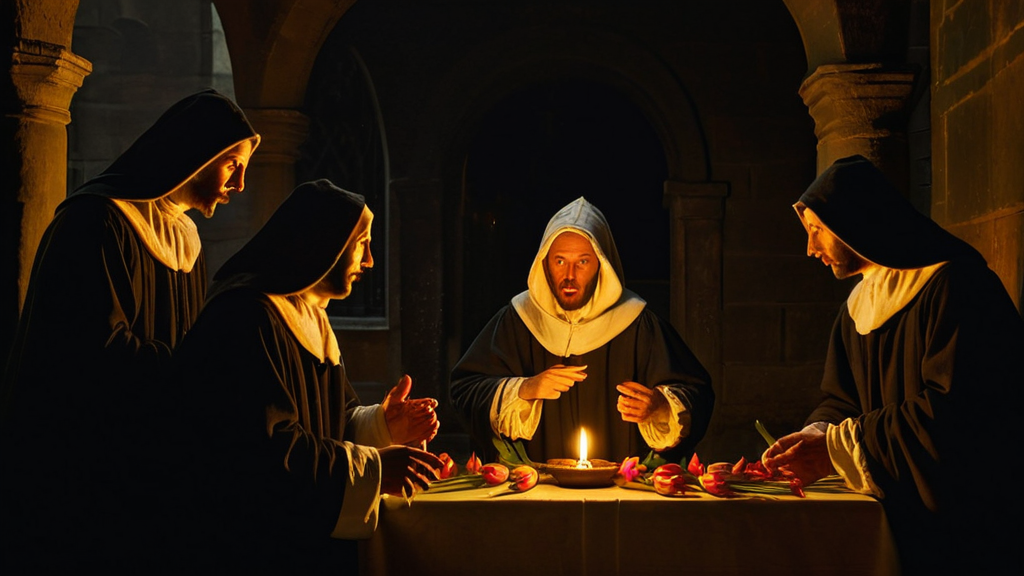
The trading happens in tavern back rooms the traders call colleges, and the colleges have real rules. Bids follow set rituals. Slates go around. Every closed deal owes a small fee called wine money, spent on exactly what the name suggests. Rowdy, smoky, half-drunk — and also, if you squint, an exchange: a place, a crowd, a method, prices called out. Almost everything a market is, this smoky room already has. What it does not have is anyone asking what the paper would be worth if the room went quiet.
The weaver's bid
I take a bench in the corner with a beer I do not drink, and I watch a weaver buy a promise.
I know his trade from his hands — the calluses of the loom are particular. He is no fool and no gambler, and men like him are all over this room. This was never a market of dukes. It was weavers and brewers and carpenters — ordinary skilled people watching neighbors get rich on paper and deciding, reasonably enough, that the ladder had finally been lowered to them.
The bulb he bids on is in the ground twenty miles away. He has never seen it flower. The slate goes around, the patter runs, and the number he finally commits to is, near as I can reckon, a year of his wages at the loom. A year of his life for a promise of a flower — and here is what I most need you to understand: in this room, tonight, it is not obviously a mistake. The price of promises has done nothing but climb for months. Every man here knows someone who sold one for double. The finest single bulbs are being valued like fine canal houses. The room's arithmetic is simple: it went up yesterday, so it goes up tomorrow.
The room is reading a chart with only one direction on it. Nobody here has ever been taught that the crowd itself is the weather — that when every buyer has already bought, the wind has nothing left to blow with.
He wins his bid. There is cheering, the wine money is drunk, and my beer goes flat while I sit like a man watching a wave from the beach, knowing what waves do.
The silence
It comes in the first days of February, and it comes not with a crash but with a silence.
A tavern in Haarlem — this same town. Bulbs offered at the going rate, the rate everyone knows, the rate that was real yesterday. And no hand goes up.
The auctioneer drops the price. Nothing. Drops it again. Nothing. No panic yet — just a room full of men discovering together that a price is not a fact about a flower. A price is an agreement between people, and agreements can simply stop.
Word moves city to city in days. And here is my favorite strange detail: two days after Haarlem went quiet, over in Alkmaar, a grand auction went ahead anyway — bulbs sold for the benefit of an innkeeper's orphaned children — and it fetched record prices, the highest honestly documented of the mania. Peak and collapse in the same week, in towns a day's walk apart. The storm does not arrive everywhere at once. It never does.
When the promises came due, the courts largely refused to enforce them — gambling on wind, said the magistrates. Most contracts were settled for a small fraction of their face — a fee paid to walk away.
Now the honesty this book owes you, because the legend and the ledgers disagree here. The legend says the tulips ruined Holland: fortunes vaporized, bodies in the canals. A historian named Anne Goldgar spent years in the actual archives — wills, notary books, small-claims courts — and the ledgers say much less. Few genuine ruins. No drowned speculators — a later invention by moralists wanting a better story. Holland sailed on, rich as ever. The famous prices were real, but the market was smaller and briefer than the legend needs it to be.
So was it nothing? No. What broke in February 1637 was not Holland's money but Holland's certainty — a whole society watched a price triple in a winter and vanish in a week, and discovered that value is not a property of things. It is a weather that moves through crowds. The mania's scale was exaggerated. The psychology was not — and the psychology is the true relic; I have measured its descendants in my own pool. The crowd's weather did not die in 1637. You traded in it last week.
Fifty years later — the courtyard
I step forward fifty years and thirty miles.
Amsterdam, 1688. No tavern this time. A great courtyard open to the sky, ringed by numbered stone columns, built over a canal so that in the early days ships could pass underneath the trading floor — a market with a river running through its bones. This is the Bourse, standing since 1611, and it is what the tavern colleges never were: a market with walls, hours, and rules that outlive any single crowd. The bell rings, the merchants pour in, and for the hours around midday the courtyard roars — grain at one pillar, timber at another, and toward the Rokin side, the corner I came for: the men who trade shares.
A share — the word is doing new work in this century — is a slice of a company. The company here is the greatest on earth, the Dutch East India Company, whose ships are a year away in the spice islands. You trade a paper claim on voyages still at sea — and around that paper, this corner has invented everything. Promises for later delivery, like the tulip men had. Contracts they call opsies — the right to buy at a set price without the duty to, Thales' old olive-press trick reborn in Dutch. Rings of traders talking a price up, rival rings talking it down — the two animal temperaments already at war. Everything on your screen was invented on these stones — not in New York, but here, in a courtyard with a canal underneath it, before anyone you have ever heard of was born.
The master — the poet of the crowd
The man I have come to meet is not the richest trader in the courtyard. He is something better: the only one writing it down.
Joseph Penso de la Vega. A Sephardi Jew whose family fled Spain and the Inquisition for this improbably tolerant city; a merchant, a philosopher, and — this matters — a poet, with a poet's eye for what people do versus what they say. He knows the market from the inside; the story goes he made and lost his fortune here several times over, though I give you that as the legend it is — the ledgers, as usual, are quieter. What is certain is the book he finished this very year: Confusion de Confusiones, written in Spanish as a conversation — a philosopher, a merchant, and a shareholder arguing about what this courtyard is. The first book ever written about a stock exchange. Not a manual — a portrait of the crowd: the greed, the dread, the rumor that moves prices before any ship's letter arrives. Distilled through the dialogue are four pieces of advice — my words, since he is owed exact ones:
First: never tell anyone to buy or to sell. Guessing right, he says, is closer to sorcery than to skill — keep your counsel.
Second: take every profit without regret. Good fortune does not hold still while you renegotiate with it.
Third — the one I crossed fifty years to hear — profits in this market are goblin treasure. In the old stories, treasure taken from goblins never stays what it was: diamonds at midnight, coal by morning; sometimes dew, and sometimes only tears. An untaken profit is enchanted money — and the enchantment is not on the money. It is on you, the holder, who cannot tell yet whether you are rich.
Fourth: whoever would get rich at this game needs both money and patience. Either alone is a slow way to lose.
I ask my one question: why write rules at all, when his own book admits on nearly every page that men in the grip of the game do not follow them?
He does not answer directly; poets rarely do. But his book answers for him, and I paraphrase it honestly: the rules were never for the crowd. A crowd cannot read while it is busy being a crowd — his father's generation proved that, one winter, over flowers. He wrote for afterward — for whoever combs the wreckage wanting to know if anyone saw it coming. Someone always did. Someone always wrote it down. The writing is the part that survives.
And history gave that answer an ending sharper than anything I could invent: de la Vega died four years later, in 1692, and his book — the first book on the first stock market, four rules a trader could tattoo on a forearm — was forgotten. Not suppressed. Not burned. Just unread, for two hundred years, until a German scholar dusted it off in 1892. Every mania in between — shares, canals, railways — happened with the warning already written, sitting in the dark of a library shelf.
Nobody hands you the lantern. It has been on the table the whole time. You have to be the one who picks it up. Now you have seen the two-hundred-year proof.
The lesson taken
Home, to the scrying pool, with two things in my pack.
The first: the crowd's weather is real, and it leaves fossils. The mania was smaller than the legend, but its shape — the climb on rising certainty, the collapse into silence when the last buyer has bought — is a pattern my pool finds in every market I pour into it. And the pool taught me one thing the tavern crowd would have paid anything to know: what a storm does when it ends. You would think the churn exhausts itself — thrashes, tires, and lies down into calm, the way a man does. We watched thousands of storms end, expecting exactly that. It is not what happens. Far more often than chance allows, the churn does not rest — it re-ignites, catching into a new wind, often within the hour. We ran the honest arithmetic on whether that could be luck; the odds came back at about one chance in two thousand. Water never rests. The silence after Haarlem was not the end of the weather. It was the next weather, loading. It always is.
The second is the poet's third rule, said in money, because that is where you live. The green number on your open trade — the profit riding because it might grow — is goblin treasure. Diamonds right now. Not yet yours. The weaver of Haarlem was, for one winter, wealthy — every promise in his coat marked up week after week — and he never banked a guilder, and in February it turned to coal in his pocket while he watched. Nothing about the paper changed. Only the crowd did. An untaken profit is a bet that the crowd's weather holds — and you know now what the pool says about weather holding. Take every profit without regret. Banked money is the only kind the goblins can't touch.
The step back
I leave at dusk, when the columns throw long shadows and the last of the shouting has moved to the coffee houses. Under the floor, the canal runs dark toward the harbor and the sea, and the sea runs everywhere.
It runs to the far side of the world — because the next place the lantern is needed is a wooden bridge over a river in Osaka, where men gather at dawn shouting prices for rice that is still green in the fields. The Dutch built a courtyard around their promises. The Japanese are about to build an entire exchange out of them — the world's first market of pure promises, sanctioned and ruled — and out of its daily battles will come the strangest gift any era leaves on our table: a way to draw a day of crowd-weather as one small picture, a body and a wick, lit like a candle.
You have ten thousand of them on your screen right now.
Step through with me. Osaka, 1697.